Why Indian Founders Register US Companies
Every week we help someone register a US company from India, and Indian founders are by a wide margin the largest group we work with. The reasons are consistent and practical rather than exotic.
Most are selling to US customers who prefer to contract with a US entity, or need access to payment infrastructure — Stripe, PayPal, Amazon Seller Central — that is materially easier to obtain with a US company and a US bank account. Some are building SaaS products where a US entity shortens enterprise procurement. Some are consultants and agencies whose American clients simply pay a US supplier faster and with less friction. A smaller group is preparing for US venture funding.
What almost nobody needs is what the aggressive end of this industry sells: a US company as a way to pay no tax. If you are resident in India, your Indian tax obligations follow you regardless of where your company is registered. A US entity changes where you invoice from. It does not change who you are for tax purposes.
This guide covers how to register a US company from India properly — the structure decision, the documents, the filing process, banking, and both the US and the Indian compliance that follows. We have flagged the parts that most guides leave out, because those are the parts that cost people money later.
Is It Legal? FEMA, LRS and RBI Rules
This is the first question almost every Indian founder asks, and the one most international formation guides skip entirely — because they are written for a global audience and the Indian regulatory layer is invisible to them.
The short answer: yes, it is legal for a resident Indian to register a US company from India and own it. But it is a reportable transaction, and the reporting is where people fall down.
The Liberalised Remittance Scheme
Under the RBI's Liberalised Remittance Scheme (LRS), a resident individual may remit up to USD 250,000 per financial year for permitted purposes, which include investment in an overseas entity. For the great majority of founders capitalising a US LLC with a few hundred or few thousand dollars, the LRS limit is not a practical constraint.
Tax Collected at Source applies on aggregate LRS remittances above Rs. 10 lakh in a financial year. For investment-purpose remittances, the rate above that threshold is 20%. TCS is not an additional tax — it is collected upfront, appears in your Form 26AS and AIS, and is set off against your income tax liability when you file your return, or refunded if you have none.
Overseas Direct Investment reporting
Investment by a resident individual into an overseas entity is governed by the Overseas Investment Rules and Regulations, 2022. In practice this means three things:
- The investment is reported to the RBI through your authorised dealer (AD) bank, and a Unique Identification Number (UIN) is allotted to the foreign entity
- An Annual Performance Report is filed for the foreign entity each year, by 31 December
- Certain activities are off-limits for resident individuals — financial services activity being the significant one
One practical wrinkle worth knowing before you approach your bank: the Overseas Investment framework is written around "equity capital", and a US LLC issues membership interests rather than shares. Most AD banks handle LLCs without difficulty, but some apply additional scrutiny or ask for the Operating Agreement and a legal characterisation. Speak to your AD bank early rather than after the entity exists, and involve your chartered accountant on the FEMA filings.
Wyoming LLC or Delaware C-Corp
Before you register a US company from India, you make one decision that determines everything downstream. It comes down to a single question: do you intend to raise US institutional venture capital?
If yes — even if the round is two or three years away — the answer is a Delaware C-Corporation. US venture funds are structured to invest in Delaware C-Corps, and converting an LLC later typically costs USD 5,000–20,000 in professional fees and can delay a round by weeks.
If no — if you are bootstrapping a SaaS product, running an e-commerce store, operating a consulting practice or an agency — a Wyoming LLC is almost always cleaner and cheaper.
| Factor | Wyoming LLC | Delaware LLC | Delaware C-Corp |
|---|---|---|---|
| Best suited to | Bootstrapped, e-commerce, SaaS, consulting | Rarely the right pick — see below | VC-funded startups |
| State filing fee | ~USD 100 | ~USD 110 | From ~USD 89 |
| Annual state cost | USD 60 annual report | USD 300 franchise tax | USD 50 report + franchise tax (USD 400 min. under APVC) |
| US entity-level tax | None by default — see classification below | None by default — see classification below | 21% federal corporate tax |
| Owner privacy | Names off public filings | Members not listed | Officers and directors disclosed |
| Can issue stock options | No | No | Yes — ISO and NSO |
| Annual IRS filing | 5472 + pro forma 1120 (single-member) or 1065 (multi-member) | 5472 + pro forma 1120 (single-member) or 1065 (multi-member) | Form 1120 (+ 5472 if applicable) |
| Ongoing complexity | Low | Low | Board minutes, stock ledger, formalities |
Note the middle column. A Delaware LLC is the structure most often sold to Indian founders who do not need it. It carries a flat USD 300 annual franchise tax against Wyoming's USD 60 — five times the annual cost for identical federal tax treatment, identical filing obligations and no additional benefit for a non-VC business. Delaware's reputation belongs to the C-Corporation, not to its LLC. Choose a Delaware LLC only where a specific counterparty or contract requires a Delaware entity. We register companies in all 50 US states and will say plainly when a cheaper state serves you better.
A New Mexico LLC is cheaper still, with no annual report at all, but has thinner banking recognition — some fintechs are slower to onboard New Mexico entities. Our three-way state comparison covers the trade-offs in detail.
Documents Needed for US Company Registration
Less than most people expect. There is no apostille, no notarisation and no embassy attestation required for US company registration from India.
What You Provide:
- Identity — Passport copy (clear scan)
- Address proof — Indian address, utility bill or bank statement
- Company name — 1st and 2nd preference
- Business activity — Plain description of what you do
- Ownership split — Percentages if multiple founders
- Registered agent — Required — CompanyVista provides
- US visit — Not required at any stage
- SSN or ITIN — Not required to form or get an EIN
You cannot use your Indian home address as the company's registered address. Every US state requires a registered agent with a physical street address in the state of formation, to receive legal and state correspondence. This is a statutory requirement, not an upsell — a filing without one will be rejected. CompanyVista provides registered agent service in all 50 states with every US formation.
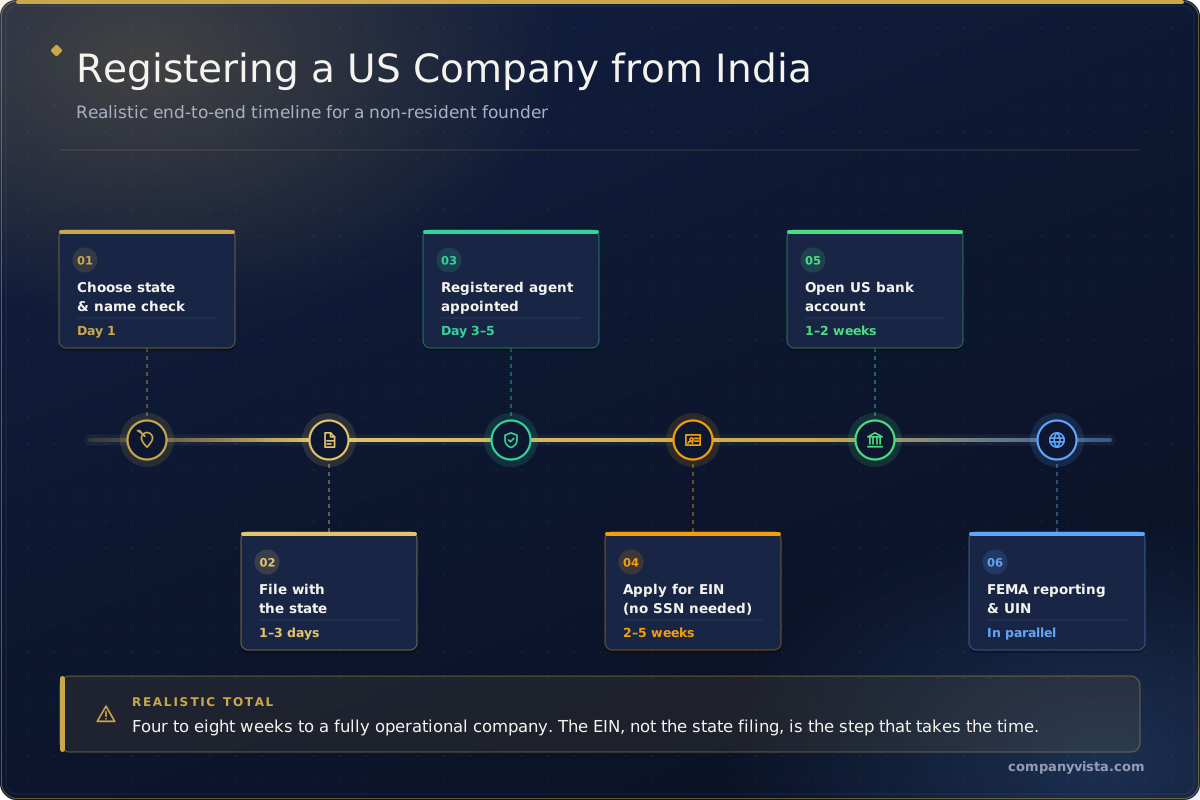
How to Register a US Company from India: Step by Step
The sequence to register a US company from India matters. Getting it out of order — most commonly applying for banking before the EIN exists — is the usual cause of delay.
- Choose the state and structure. Wyoming LLC or Delaware C-Corp for most founders, with the exceptions noted above.
- Check name availability. Names are cleared against the Secretary of State's register. Have a second preference ready.
- Appoint a registered agent in the state of formation.
- File the formation document. Articles of Organization for an LLC, Certificate of Incorporation for a C-Corp. Wyoming is typically same or next business day; Delaware varies with the service level chosen.
- Adopt the internal governing document. An Operating Agreement for an LLC, bylaws and share issuance for a C-Corp. Banks and payment processors ask for this, and your AD bank may want it for the FEMA filing.
- Apply for the EIN. Covered in the next section — this is the step where non-residents lose time.
- Open the business bank account once the EIN letter is issued.
- Complete the FEMA reporting through your AD bank and obtain the UIN.
Steps 1 to 5 are usually complete within a week. Step 6 is the variable one, and step 8 runs in parallel once the entity exists.
Getting Your EIN Without an SSN
An EIN (Employer Identification Number) is the company's federal tax ID. Nothing practical happens without it — no bank account, no Stripe, no Amazon seller account.
The obstacle for Indian founders is that the IRS online EIN application requires the applicant to have an SSN or ITIN. Without one, you cannot use the online route. This leads a lot of people to conclude, wrongly, that they need an ITIN first.
Realistic timing: fax submissions are typically processed in a few weeks; mail is slower. Anyone promising an EIN in 24 hours for a non-resident applicant is describing the online route, which is not available to you without an SSN or ITIN. Our full walkthrough is in how to get a US EIN without an SSN.
Opening a US Bank Account from India
Once your US company registration is complete, banking is the next step. Traditional US banks generally require in-person account opening, which makes them impractical from India. The realistic options are US fintech business banking platforms that support remote onboarding.
CompanyVista works directly with three platforms that onboard non-resident founders remotely. We hold partner arrangements with each, which means our clients go through a known route rather than a cold application — but none of them, and no adviser, can promise you an approval. Each runs its own risk assessment.
Mercury — the default US business account
Mercury is the most widely used option among non-resident LLC owners, and for most Indian founders it is the right first application. You get a genuine US business checking account with account and routing numbers, which is what Stripe, Amazon and US clients expect to pay into. Mercury is a financial technology company rather than a bank; banking services are provided through its partner banks.
Lili — built for solo founders and freelancers
Lili onboards non-residents fully remotely with no SSN required, with banking services provided by Sunrise Banks, N.A. It suits solo consultants, freelancers and single-owner e-commerce businesses, and folds in bookkeeping and tax-set-aside tools that a freelancer would otherwise buy separately. One practical detail: you will need a US mailing address for debit card delivery, which your registered agent service can usually provide.
Payoneer — for marketplace and cross-border receipts
Payoneer does a different job, and it is worth being clear about the difference rather than presenting it as an alternative. Payoneer gives you receiving accounts in USD, EUR, GBP and other currencies, and withdraws to your Indian bank account. It is the strongest option where your income arrives through marketplaces and platforms — Amazon, Upwork, Fiverr, ad networks — and where getting funds into India cleanly matters as much as holding them in the US.
For most Indian founders the sensible setup is a US business account for operations and Payoneer alongside it for marketplace receipts and repatriation. They are complementary, not competing.
All three require the same core documents: the EIN confirmation letter, your formation documents, the Operating Agreement or bylaws, and passport identification. Our guide to USD business accounts for non-residents covers the application process in detail, and Mercury vs Payoneer vs Lili compares them side by side.
Stripe, PayPal and Payment Processing
For most Indian founders, payment processing is the actual reason to register a US company from India, so it is worth being precise about what unlocks what.
With a US company, an EIN and a US business bank account, you can apply to Stripe directly. You do not need a separate incorporation product to access it. PayPal Business and Amazon Seller Central follow the same pattern — US entity, EIN, US bank account.
Two honest qualifications. First, having a US entity improves your position with payment processors; it does not guarantee acceptance, and high-risk business categories remain difficult regardless of where you are incorporated. Second, if your customers are Indian and your operations are in India, a US entity in the payment path may create questions on both the FEMA and GST side. That structure needs professional advice specific to your facts, not a template.
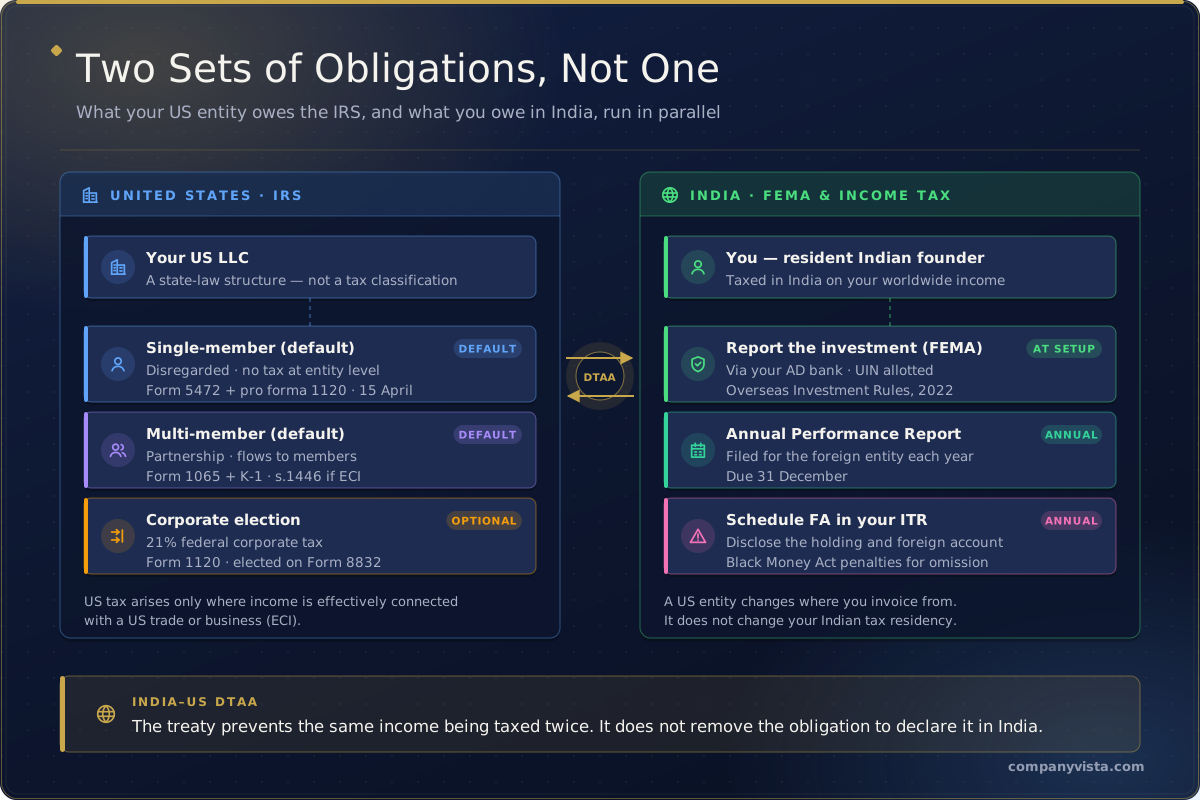
Tax: What You Pay in the US and India
Tax is where the honest answer about US company registration from India differs most sharply from the marketing you will encounter.
The US side: your LLC's tax classification is a choice, not a given
This is the most widely misstated point in guides written for non-resident founders, including — until recently — a lot of otherwise careful ones. An LLC is not a tax classification. It is a state-law structure that can be taxed in three different ways, and which one applies to you determines what you file and whether anyone pays tax at entity level.
| Single-member (default) | Multi-member (default) | Corporate election | |
|---|---|---|---|
| Treated as | Disregarded entity | Partnership | Corporation |
| How you get it | Automatic | Automatic | Form 8832 election |
| Federal tax at entity level | None — looked through | None — flows to members | 21% corporate tax |
| Main annual IRS filing | Form 5472 + pro forma 1120 | Form 1065 + Schedule K-1 | Form 1120 |
| If income is effectively connected | Owner files Form 1040-NR | Partnership withholds under s.1446, files 8804/8805 | Corporation pays; distributions withheld |
| Form 5472 applies | Yes | No — 1065 regime instead | Yes, if 25% foreign-owned |
Single-member, no election. The LLC is a disregarded entity — the IRS looks through it to you. No federal tax at entity level. This is the default most Indian founders end up in, and it is where the Form 5472 obligation bites.
Multi-member, no election. Two or more members means partnership treatment by default. The LLC files Form 1065 and issues Schedule K-1 to each member. If any of the income is effectively connected with a US trade or business, the partnership must withhold on the amount allocable to foreign partners under section 1446 — at the highest individual rate for individual partners — and file Forms 8804 and 8805. This is a real obligation on the partnership itself, not on you personally, and it is expensive to discover late. If you are forming with a co-founder, this is the paragraph to reread.
Either one, with a corporate election. Filing Form 8832 causes the LLC to be taxed as a corporation: 21% federal corporate income tax, Form 1120, and a second layer of tax on distributions. Founders occasionally elect this to stop income flowing through to them personally, or for a specific treaty or state reason. It is rarely the right answer for a bootstrapped business, and it should never be done casually — a wrong election is difficult to unwind.
Do you actually owe US federal tax?
Separate from classification: whether tax is due at all turns on whether the income is effectively connected income (ECI) with a US trade or business. For a founder living in India, with no US office, no US employees or dependent agents, and services performed from India, business profits commonly fall outside US federal income tax. That outcome is fact-specific, not automatic, and having US customers alone does not create ECI.
A Delaware C-Corporation sits outside this analysis entirely: it is a separate taxpayer and pays 21% federal corporate income tax on its profits regardless, with dividends taxed again on distribution.
The India side
As a resident and ordinarily resident individual, you are taxed in India on your worldwide income. Income earned through your US entity does not escape Indian taxation because the entity sits abroad.
Two Indian requirements deserve particular attention:
- Schedule FA — foreign assets, including your interest in the US entity and any foreign bank account, must be disclosed in your Indian income tax return. Non-disclosure is dealt with under the Black Money Act, where the penalty for undisclosed foreign assets can be Rs. 10 lakh, independent of the tax involved.
- Place of Effective Management — a foreign company managed from India can be treated as an Indian tax resident. CBDT guidance provides that POEM provisions are not applied to companies with turnover at or below Rs. 50 crore in a financial year, which places most early-stage founders outside it, but it is worth understanding as you scale.
Where tax has genuinely been paid in the US, relief is available under the India-US Double Taxation Avoidance Agreement. The treaty prevents the same income being taxed twice. It does not remove the obligation to declare it.
"A US company changes where you invoice from. It does not change who you are for tax purposes. Any adviser who tells an India-resident founder that a Wyoming LLC means zero tax is describing a compliance problem, not a structure."
Annual Compliance in Both Countries
To register a US company from India is a one-week task. Keeping it compliant is an annual one, in two jurisdictions.
| Obligation | Where | When |
|---|---|---|
| Form 5472 + pro forma 1120 (single-member LLC) | USA — IRS | 15 April |
| Form 1065 + Schedule K-1 (multi-member LLC) | USA — IRS | 15 March |
| Form 1120 corporate return (C-Corp) | USA — IRS | 15 April |
| State annual report | USA — State | Varies by state |
| Delaware franchise tax (C-Corp) | USA — Delaware | 1 March |
| Registered agent renewal | USA — State | Annual |
| Annual Performance Report (APR) | India — RBI via AD bank | 31 December |
| Schedule FA disclosure in ITR | India — Income Tax | With annual return |
US Company Registration Cost and Timeline
There are two separate costs, and conflating them is how founders end up feeling misled. State fees are paid to the US state government. Service fees are what you pay a filing firm to prepare, file and support the entity. State fees alone will not get you an operating company.
State fees (paid to the state)
A Wyoming LLC costs approximately USD 100 to file, with a USD 60 minimum annual report thereafter. A Delaware LLC costs about USD 110 to file and carries a flat USD 300 annual franchise tax. A Delaware C-Corporation starts at roughly USD 89 to file, with a USD 50 annual report plus franchise tax each year — and that franchise tax should always be calculated using the Assumed Par Value Capital method, because the Authorized Shares method can produce a bill of tens of thousands of dollars for a startup with a standard 10,000,000-share cap table.
CompanyVista service fees
Our US formation packages start at two levels, in addition to state fees. The difference is not really a feature list — it is how much of the process you want to run yourself.
Standard — from USD 299 + state fees
This suits founders who know roughly what they need and want the entity, EIN and banking route set up correctly, without ongoing handholding afterwards. It covers the state filing and formation documents, registered agent for the first year, the Operating Agreement, and the EIN application. Ongoing filings are quoted separately as they fall due.
In practice this is the right fit for:
- Freelancers and independent consultants invoicing US clients
- Amazon FBA sellers and single-store e-commerce operators
- Solo SaaS founders validating a product before committing further
- Founders who already have a chartered accountant in India handling their side, and need only the US entity built properly
Premium — from USD 599 + state fees
This suits founders for whom the US company is the business rather than a structure alongside it, and where a missed filing would cost considerably more than the difference in fee. It adds active coordination of the bank account application rather than guidance on it, the first-year Form 5472 filing, and a compliance calendar covering both the US and Indian deadlines.
In practice this is the right fit for:
- Multi-member LLCs, or any business with partners, investors or a revenue share — the partnership filings alone justify the support
- Founders who want the bank application actively worked rather than explained
- Businesses expecting real transaction volume in the first year
- Anyone without an adviser who understands both the US filings and the Indian FEMA and Schedule FA side
Both are starting prices, not a ceiling. Multi-member entities, C-Corporations with share structures, expedited state processing and ITIN applications are priced on scope. Where your situation needs more than a package covers, we tell you before you pay rather than after. Current package details are on our pricing page, and every engagement begins with a written quote.
Timeline
State formation is usually one to three business days in Wyoming. The EIN is the variable step and realistically takes a few weeks for non-resident applicants. Bank account opening follows the EIN and is typically one to two weeks. A realistic end-to-end expectation from India is four to eight weeks to a fully operational company with banking. Anyone quoting five to seven days end-to-end is describing the state filing and omitting everything after it.
Mistakes Indian Founders Make
These are the recurring mistakes we see when founders register a US company from India, in rough order of how expensive they turn out to be.
- Never reporting the investment under FEMA. The US entity is formed, the business runs for years, and no UIN was ever obtained and no APR ever filed. Regularising this later is slower and costlier than doing it correctly at the outset.
- Omitting Schedule FA from the Indian return. Founders often assume disclosure begins when they take money out. It does not — the holding itself is disclosable, and the Black Money Act penalty is significant.
- Missing Form 5472. Usually because whoever formed the company never mentioned it. USD 25,000 per year, regardless of revenue.
- Adding a co-founder without realising the entity changed. A second member converts the LLC from disregarded to partnership treatment, replacing the Form 5472 route with Form 1065, K-1s and possible section 1446 withholding. Nothing in the state filing warns you.
- Forming a C-Corp with no funding plan. You take on 21% corporate tax, franchise tax and formal governance in exchange for benefits you will not use. If VC is not on your roadmap, an LLC is the better structure.
- Choosing Wyoming for a staffing business. The insurance and workers' compensation position makes it the wrong state for this sector.
- Expecting a visa. Owning a US company confers no immigration status, work authorisation or right of entry to the United States. These are entirely separate systems.
How CompanyVista Helps
CompanyVista is a document filing, taxation and accounting firm — not a law firm — led by Rakesh Kumar, a US-credentialed CPA, IRS Enrolled Agent and Certified Acceptance Agent, with offices in Noida NCR and Albuquerque, New Mexico.
That combination matters for Indian founders specifically: we handle the US formation, the registered agent, EIN and ITIN applications, the Form 5472 filing and business banking where needed, while understanding the Indian side of the picture that a US-only provider will not raise with you.
Every engagement begins with a free consultation and a written quote. We will also tell you when you do not need a US company — which happens more often than the rest of this industry admits.