Why Staffing Is Different From Every Other US Business
Staffing company registration in the USA looks, on paper, like any other formation. File with a state, get an EIN, open a bank account. Founders who have set up a consulting or e-commerce company abroad reasonably assume this will be the same exercise with a different industry label on it.
It is not, and the reason is one word: employees. A US staffing company is an employer from its first placement, and almost no other US company a non-resident forms ever becomes one.
Almost every other business a non-resident forms in America has no US payroll. A US LLC selling software or taking Stripe payments has an owner and perhaps some contractors. A staffing agency has people on its own payroll, working at someone else's site, under someone else's supervision, and that single fact pulls in federal employment law, state employment law, unemployment insurance, workers' compensation, immigration verification and a set of insurance requirements your clients will enforce more strictly than any regulator.
So the useful way to read this guide to staffing company registration is in two halves. Forming the company is a week. Becoming an employer that the IRS, the state and a corporate client will all accept is the rest of it.
Entity Choice: LLC, C-Corp, and Why Not an S-Corp
Three structures come up for a US staffing company, and for a non-resident only two are actually available.
| Structure | Available to you? | When it fits a staffing business |
|---|---|---|
| LLC | Yes | The default. Simple, flexible, and fine for an agency billing commercial clients. Taxed as a disregarded entity or partnership unless you elect otherwise. |
| C-Corporation | Yes | Where you want outside investment, a clean share structure for partners, or clients and prime contractors who prefer dealing with a corporation. |
| S-Corporation | No | Closed to you. The tax code does not permit nonresident aliens to hold S-Corp shares, so the election American staffing owners use is unavailable. |
The S-Corp point deserves emphasis because it is the single most common piece of bad advice given to non-resident staffing founders. US-based accountants recommend the S-election reflexively, because for an American owner-operator it reduces self-employment tax on distributions. But the eligibility rules are explicit: shareholders must be individuals, certain trusts or estates, and nonresident aliens are not permitted. If someone has told you to form an S-Corp, they have not registered that you live outside the United States.
Between the two that remain, the honest answer is that it rarely matters as much as people think at the start. A US LLC is simpler and cheaper to run, and most agencies begin there. Our comparison of the Delaware C-Corp for non-residents sets out when the corporate route earns its extra cost.
The Best States for Staffing Company Registration
Our recommendation for staffing company registration in the USA is consistent: Texas, Florida or Georgia, and the reason is insurance and employment infrastructure rather than tax.
| Texas | Florida | Georgia | |
|---|---|---|---|
| State personal income tax | None | None | Yes |
| Workers' compensation | Optional for private employers | Required: 1 employee in construction, 4 otherwise | Required at 3 or more employees |
| Private insurance market | Competitive | Competitive | Competitive |
| E-Verify for private employers | No state mandate | Required at 25+ employees | Required at 11+ employees |
| Formation cost | USD 300 | USD 125 | Low |
| Typical fit | Texas: energy, logistics, industrial, IT | Healthcare, hospitality, logistics, LatAm-facing | Logistics, warehousing, manufacturing |
Read that table and a pattern appears: the three states are close on the things that matter and differ on details you can plan around. Texas costs more to form and nothing to maintain. Florida costs less to form and has one hard annual deadline. Georgia sits between them but has a state income tax and the lowest E-Verify threshold of the three.
Why Wyoming Is the Wrong Answer
Wyoming is an excellent state for a great many a US company, and we form entities there constantly. For staffing specifically we do not recommend it, and the mechanism is worth understanding rather than taking on trust.
Wyoming is a monopolistic workers' compensation state — one of only four, with Ohio, North Dakota and Washington — where an employer cannot buy workers' compensation from a private insurer at all. Cover must come from the state fund, and that fund does not include employers' liability. To get employers' liability you bolt a stop-gap endorsement onto a general liability policy from a different carrier.
For a staffing company placing workers across several states, that is an awkward insurance programme to assemble, brokers charge for the awkwardness, and your client's procurement team will ask why your certificate of insurance looks unusual. None of that is fatal. It is simply friction you do not need when Wyoming's real advantages — low cost and privacy — are worth least to a business whose name goes on every worker's payslip.
Do You Need a Staffing Agency Licence?
This is where generic advice does the most damage, because the answer splits sharply by niche.
- General commercial, IT and professional staffing — in most states no specific staffing licence applies, which makes this the fastest route to launch. We confirm the position for your niche and state in writing before you commit to either.
- Healthcare and nurse staffing — licensed or registered in many states, often under nurse registry or home health agency rules, with their own bonding, supervision and inspection requirements. Budget for it and build it into your timeline.
- Professional employer organisations and employee leasing — licensed in a majority of states — Texas licenses PEOs through its Department of Licensing and Regulation, and Florida through the Board of Employee Leasing Companies. Texas is a common base for staffing founders precisely because that distinction is well documented there. If you intend to co-employ rather than place, you are in this category.
- Talent, entertainment and some trade-specific agencies — separate licensing regimes again.
The practical rule: establish which of those you are before you form, because the answer can change the state you choose and will certainly change your launch date. We identify the licensing position for your niche and handle the applications where they apply — healthcare staffing registrations and PEO licensing included.
Staffing Company Registration: Becoming a US Employer
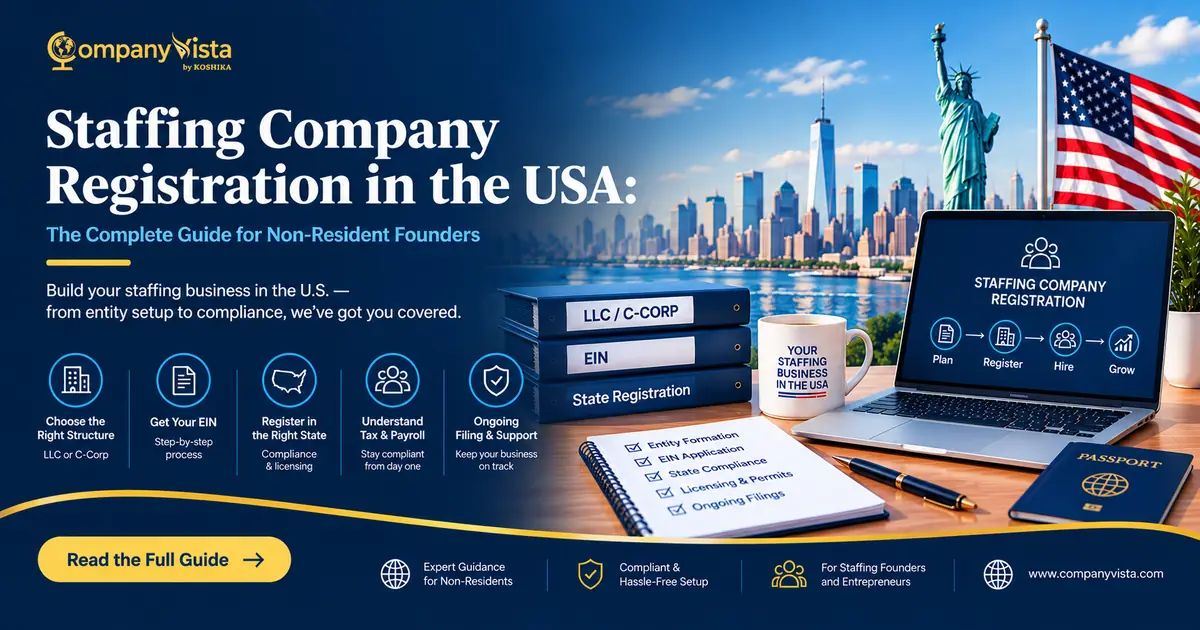
Here is the staffing company registration sequence after the US entity exists. Most guides stop at the EIN; the ones below it are where real time goes.
| Step | What it is | When |
|---|---|---|
| 1. Entity formation | LLC or C-Corp, registered agent, governing documents. | Days |
| 2. EIN | Federal tax ID, obtained through our EIN service or direct. Non-residents cannot use the IRS online tool. | Same day to several weeks |
| 3. State withholding account | Registered in every state where a worker is placed. | Per state, before first payroll |
| 4. State unemployment insurance account | SUTA. Also per state, and it carries its own rate. | Per state, before first payroll |
| 5. Workers' compensation policy | Thresholds vary by state and industry. Construction is almost always from the first worker. | Before first worker |
| 6. New hire reporting | Each new employee reported to the state directory, typically within 20 days. | Per hire |
| 7. Payroll system | Provider or bureau able to handle multi-state filing. | Before first payroll |
| 8. Insurance package | General liability, employers' liability, professional indemnity, often cyber. | Before first contract |
| 9. SAM registration | Only if you intend to bid for federal work. | Optional, allow weeks |
Steps 3 and 4 repeat for every state you place workers in. A staffing agency with people in four states runs four sets of registrations, four unemployment rates and four filing calendars. That is normal in US staffing, and it is the main reason agencies outgrow spreadsheets quickly.
I-9 and E-Verify: The Compliance That Bites Hardest
These two get conflated constantly by staffing agency founders. They are different obligations with different scope.
Form I-9 is universal. Every US employer must complete an I-9 for every employee, in every state, with no size threshold. The employee completes Section 1 no later than their first day of work, and the employer completes Section 2 within three business days of the start date. I-9 forms are retained until the later of three years after hire or one year after termination.
Penalties are not trivial. Uncorrected technical or paperwork errors run from roughly USD 716 to USD 2,861 per form, and knowingly hiring an unauthorised worker reaches tens of thousands of dollars per worker, alongside possible debarment from federal contracting. For a staffing agency running hundreds of hires a year, sloppy I-9 practice is a systemic exposure rather than an isolated mistake.
E-Verify is conditional. Unlike the I-9, there is no blanket federal E-Verify mandate for private employers, but it applies if you hold federal contracts with the relevant clause, and several states require it outright:
| Where | E-Verify requirement for private employers |
|---|---|
| Alabama, Arizona, Mississippi, South Carolina | All private employers |
| Georgia | 11 or more employees |
| Florida, North Carolina | 25 or more employees |
| Tennessee | 35 or more employees |
| Utah | Larger employers only |
| Texas | No private-sector mandate |
| Federal contractors | Enrol within 30 days of award; verify contract staff within 90 days; new hires within three days |
Payroll Taxes and the Filing Calendar
Once your US staffing company has employees, a recurring federal and state calendar begins, and it runs whether or not you are placing anyone that month.
- Form 941 — the employer's quarterly federal tax return, reporting income tax withheld and both halves of Social Security and Medicare.
- Form 940 — the annual federal unemployment (FUTA) return, due 31 January. FUTA is 6.0% on the first USD 7,000 of each employee's wages, with a credit of up to 5.4% for state unemployment paid on time, giving a net 0.6% in most states.
- W-2 and W-3 — annual wage statements to each employee and to the Social Security Administration.
- State withholding and SUTA returns — in every state where you have placed workers, on each state's own schedule.
- Federal tax deposits — made on a monthly or semi-weekly schedule depending on your history, not annually.
And underneath all of it, the obligations that attach to the company because it is foreign-owned do not go away. A foreign-owned single-member US LLC still files Form 5472 with a pro forma Form 1120, at a USD 25,000 penalty per form per year, entirely separately from anything payroll-related.
Insurance: The Certificate That Gates Every Contract
No corporate client will sign with a US staffing company that cannot produce a certificate of insurance, and the certificate usually has to name them as an additional insured. In practice this, not any licence, is the real gate on the business.
A typical staffing agency insurance package covers general liability, employers' liability, workers' compensation, and professional indemnity or errors and omissions. Healthcare staffing adds professional liability for the clinicians placed; IT staffing often adds cyber.
This is why the state choice matters so much for staffing and so little for other businesses. Texas, Florida and Georgia all have competitive private workers' compensation markets where a broker can place the whole programme with commercial carriers. Wyoming cannot, for the reason set out above. CompanyVista is not an insurance broker and does not advise on cover — but we will tell you plainly when a state choice is about to make your cover harder to buy.
Federal Registrations: SAM, the UEI and Your D-U-N-S Number
Staffing is one of the largest federal contracting categories in the United States, and enterprise clients run their own vendor onboarding that looks much the same. Both routes need identifiers, and we register all of them for you.
| Registration | What it is for | CompanyVista handles it |
|---|---|---|
| Unique Entity ID (UEI) | The identifier for federal awards, issued through SAM.gov. It replaced the DUNS number for this purpose in April 2022. | Yes |
| SAM registration | Full System for Award Management registration. Required to actually receive federal awards — a UEI on its own is not enough. | Yes |
| D-U-N-S number | Dun & Bradstreet's business identifier. No longer the federal identifier, but still requested constantly in corporate vendor onboarding, supplier portals, trade credit and business credit files. | Yes |
| Entity validation | SAM verifies your legal name and address against documentation. Mismatches are the usual cause of rejection and delay. | Yes |
| NAICS and SIC codes | Industry classification used across federal and corporate procurement, and by insurers when rating your business. | Yes |
| State vendor registration | Many states run their own supplier portals separately from SAM. | Yes |
The point worth understanding is that these are three different things doing three different jobs. The UEI is what the federal government uses to identify your company, and every federal award record carries it. SAM is what lets you bid and be paid. The D-U-N-S number is what a corporate procurement team or a credit insurer asks for, and a staffing agency chasing enterprise accounts is asked for it regularly — which is why we register it alongside the rest rather than treating it as optional.
Federal work also brings the E-Verify contractor clause with it, so the sections above connect: winning a federal contract puts your US staffing company into E-Verify even in a state with no mandate. We enrol you and set the process up.
Banking, Payroll Funding and the Cash Gap
Now the section that matters most, and that almost no staffing guide written for non-residents covers honestly.
Every staffing agency has the same structural timing problem. You run payroll weekly or fortnightly. Your client pays on 30, 45 or 60 day terms. Between placing a worker and being paid for them, you fund their wages yourself — and the faster you grow, the larger that gap becomes. A new agency that wins a good contract can fail because it won it.
Three routes exist, and most agencies use a combination:
- Your own reserves. Simplest and cheapest, and it caps your growth at what you can fund. A new US LLC with thin reserves should take only contracts it can actually payroll.
- Payroll funding or invoice factoring. A funder advances against your approved invoices and is repaid when the client pays. Standard practice in US staffing, priced accordingly, and worth understanding before you need it.
- Client terms. Negotiating shorter terms, or weekly billing, moves the problem more cheaply than financing it. Underused by new agencies, who assume the terms offered are fixed.
On banking, a US staffing company needs a US company account that handles outbound payroll reliably and at volume. Several platforms onboard non-resident owners remotely once the company has an EIN — our guide to USD business accounts for non-residents compares them, and the Mercury, Payoneer and Lili comparison goes platform by platform. Confirm payroll and ACH capability specifically, because an account that works perfectly for invoicing may be a poor fit for running a payroll.
Mistakes Non-Residents Make in US Staffing
| Mistake | What it costs |
|---|---|
| Taking S-Corp advice | Nonresident aliens cannot hold S-Corp shares. The election will be invalid, and unwinding it is expensive and avoidable. |
| Forming in Wyoming for the privacy | Monopolistic workers' compensation and no employers' liability in the state fund. The insurance programme becomes a project. |
| Registering payroll only in the formation state | Payroll registration follows the worker. Placing someone in another state means registering there, before their first payday. |
| Treating the I-9 as paperwork | I-9 Section 2 is due within three business days of the start date. At agency hiring volumes, a sloppy process becomes a systemic liability. |
| Assuming E-Verify does not apply | E-Verify thresholds are low and agencies cross them fast — 11 employees in Georgia, 25 in Florida. Federal contracts trigger it regardless of state. |
| Assembling registrations from five different providers | Your legal name and address must match exactly across the state filing, EIN, SAM, D-U-N-S and your insurance certificates. Piecemeal setup is how mismatches creep in and onboarding stalls. |
| Classifying placed workers as 1099 contractors | Where the client controls hours and supervision, they are employees. Misclassification brings back taxes, penalties and client indemnity claims. |
| Planning the funding after the first contract | The cash gap arrives with the first payroll run, not the first invoice. Agencies fail from growth more often than from lack of it. |
How CompanyVista Helps
Staffing is the largest single industry among our clients, and we built our service around it so that a founder does not have to assemble a US staffing company from five different providers. Everything below is handled in-house or through our own credentialed team.
| Stage | What we handle for your staffing company |
|---|---|
| Entity | US LLC or C-Corporation in the right state, registered agent in all 50 states, Operating Agreement or bylaws, and foreign qualification where you expand into additional states. |
| Tax IDs | EIN by whichever route is open to a non-resident, and ITIN applications through our Certified Acceptance Agents without mailing your passport. |
| Employer set-up | State withholding and unemployment insurance accounts in every state where you place workers, new hire reporting set-up, and the payroll filing calendar. |
| Federal registrations | SAM registration, the Unique Entity ID (UEI), the D-U-N-S number, NAICS and SIC classification, state vendor portals, and E-Verify enrolment. |
| Licensing | Niche licensing review, healthcare and nurse staffing registrations, and PEO or employee-leasing licensing where you intend to co-employ. |
| Banking | US business account coordination with platforms that onboard non-residents, chosen for payroll and ACH capability rather than just invoicing. |
| Ongoing compliance | Forms 941 and 940, W-2s and W-3, state withholding and SUTA returns, annual reports, and the federal filings your company carries as a foreign-owned entity including Form 5472. |
| Accounting | Bookkeeping, financial statements and year-end returns, prepared by US-credentialed CPAs and IRS Enrolled Agents. |
That is the whole stack from formation to a running payroll, on one calendar and with one point of contact. The alternative — a formation agent here, a registered agent there, a separate firm for the EIN, someone else for SAM and D-U-N-S — is how legal names drift apart across records and how onboarding with a large client stalls at vendor validation.
Where you need something we do not do ourselves, we say so and work alongside people who do. We are a document filing, taxation and accounting firm: we do not sell insurance and we do not give legal advice, so cover goes through licensed brokers and legal questions through independent attorneys in the relevant state. Our compliance and accounting support keeps all of it running once the agency is live.
Our team works across our Noida NCR and New Mexico offices and includes US-credentialed CPAs, IRS Enrolled Agents and Certified Acceptance Agents. US formation packages start at USD 299 plus state fees, with optional add-ons for the registrations above selected as you need them, and the price shown before any payment.