
Why Non-Residents Are Sent to Texas
A Texas LLC is usually recommended for one of two reasons, and only one of them survives scrutiny. Both matter more than they look, because for most founders abroad this is really a decision about where to put a US company rather than a decision about Texas.
The reason people repeat is tax. Texas has no state personal income tax and no conventional state corporate income tax, and for a founder comparing states on a spreadsheet that looks decisive. It is also the reason that matters least to most non-residents, because a foreign owner of a US LLC in Wyoming, New Mexico or Florida is in much the same position on state income tax anyway. Choosing a Texas LLC for that alone is choosing a higher filing fee for a benefit several cheaper states already give you.
The reason that holds up is operational. Texas has the second-largest state economy in the United States, a deep commercial insurance market, and a regulatory posture that suits businesses which actually employ people. If your company will have staff, contracts, clients or a physical presence in the United States, a Texas LLC stops being an arbitrage play and starts being the obvious home for the business.
Who a Texas LLC Actually Suits
We form companies in every US state, and the pattern of who is well served by a Texas LLC — rather than by a US LLC somewhere cheaper — is consistent enough to write down.
| Texas is a good fit if | Look elsewhere if |
|---|---|
| You are building a staffing or recruiting business | You want the cheapest possible US entity |
| You will hire US employees or W-2 contractors | The company is a dormant holding vehicle |
| Your clients are US enterprises who vet suppliers | You need members kept off the public record |
| You expect meaningful US revenue within two years | You are testing an idea and may close in a year |
| You need commercial insurance placed easily | You are raising venture capital and need a C-Corp |
Two of those deserve expanding. On privacy, a Texas LLC is not a quiet company: the annual report discloses the managers or managing members of the company, and it is public. Wyoming and New Mexico do not collect member names at all. If keeping ownership off a public register matters to you, Texas is the wrong choice and you should say so early rather than discover it in May.
On venture funding, a Texas LLC is not what institutional investors expect. US venture capital is built around the Delaware C-Corp, and converting later is possible but costs money and creates tax questions. If a priced round is a realistic plan within eighteen months, start with the structure investors will ask for.
The Staffing Question, and Why Not Wyoming
Staffing and recruiting is the largest single industry among our clients, and a Texas LLC is where we send most of them. The reason is insurance, not tax, and it is worth explaining properly because almost nobody does.
A staffing business has workers, and that single fact drives almost every argument for a Texas LLC over a cheaper state. Workers mean workers' compensation cover, employers' liability, general liability and professional indemnity — and your clients will not sign until they have seen a certificate of insurance naming all of it. Getting that certificate is the practical gate on the business, and the state you formed in decides how hard it is to pass.
Wyoming is a monopolistic workers' compensation state. It is one of only four — alongside Ohio, North Dakota and Washington — where an employer cannot buy workers' compensation from a private insurer at all. Cover must come from the state fund, and the state fund does not include employers' liability. To get that, you bolt a stop-gap endorsement onto a general liability policy from a different carrier. For a staffing company placing workers across several states, that is a genuinely awkward programme to assemble, and brokers charge for the awkwardness.
Texas sits at the opposite end. It is the only state in the country where workers' compensation is not compulsory for private employers, and it has a fully competitive private market. Workers' compensation, employers' liability and professional indemnity can all be placed with commercial carriers through a single broker, which is exactly the package a staffing client's procurement team expects to see.
Wyoming remains an excellent state for a great many businesses, and we form companies there constantly. For staffing specifically, we do not recommend it, and this is why. If your model places workers with clients, plan the insurance before you pick the state.
What Texas Requires to Form an LLC
The requirements are short, and none of them exclude a non-resident.
- A distinguishable name ending in "Limited Liability Company", "Limited Company", or an abbreviation such as LLC, L.L.C. or LC. It must be distinguishable on the Secretary of State's records from every existing entity.
- A registered agent with a physical street address in Texas, who has consented in writing to serve. This is the requirement non-residents most often get wrong, and it has its own section below.
- A governing authority — the company states whether it is managed by managers or by its members, and names them. These details go on the public record.
- An organizer, who signs the Certificate of Formation. The organizer need not be a member and need not be in Texas.
- A stated purpose, which for almost all companies is the standard any-lawful-purpose wording.
There is no citizenship requirement, no residency requirement, no US visa requirement and no requirement to hold a Social Security Number. A founder who has never entered the United States can own a Texas LLC outright.
The Registered Agent Rule Non-Residents Get Wrong
Every Texas LLC must name a registered agent, and Texas is stricter about it than founders expect. The mistake is expensive, because it can invalidate the filing.
The registered agent must be an individual resident in Texas, or an entity authorised to transact business in Texas. The agent's office must be a physical street address inside Texas at which the agent can be personally served during business hours. A post office box does not qualify. A mail-forwarding or virtual-office address does not qualify. The Secretary of State cannot act as your agent, and the company cannot act as its own agent.
The agent must also have consented in writing before being named. Naming a service you have not actually engaged, or a friend who has not agreed, is a defective filing.
Every US company must keep one, and for a non-resident this is not optional infrastructure — it is the state's only reliable route to reach you, and losing service of process because an address went stale is how companies end up with default judgments they never heard about. A commercial registered agent service handles it, forwards what arrives, and keeps the address current.
How to Form a Texas LLC, Step by Step
With the agent in place, forming a Texas LLC is a short and predictable sequence. The only step with a genuinely variable timeline is the federal one.
| Step | What happens | Typical timing |
|---|---|---|
| 1. Clear the name | Check the proposed name is distinguishable on Secretary of State records. Have a second and third choice ready. | Same day |
| 2. Appoint a registered agent | Engage a commercial agent with a Texas street address and obtain written consent. | Same day |
| 3. File the Certificate of Formation | Form 205, filed online or by post with the Secretary of State. USD 300. | Filing day |
| 4. Receive approval | Processing time varies with volume. Expedited tiers are available at extra cost. | Days, or faster if expedited |
| 5. Apply for the EIN | Form SS-4 with the IRS. Non-residents cannot use the online tool and apply by phone, fax or post. | Same day to several weeks |
| 6. Adopt an operating agreement | Not filed with the state, but banks ask for it and it governs how the company runs. | With formation |
| 7. Open banking | Platform-dependent, and separate from the state you chose. | Days to weeks |
| 8. Register with the Comptroller | Set up the franchise tax account so the annual report can be filed. | After formation |
Step 5 is where most non-resident timelines actually slip, and it has nothing to do with Texas. The IRS online EIN tool is closed to applicants without a Social Security Number, and the alternatives vary from same-day to over a month. Our guide to getting an EIN without an SSN covers the routes in detail.
What a Texas LLC Costs in Year One and After
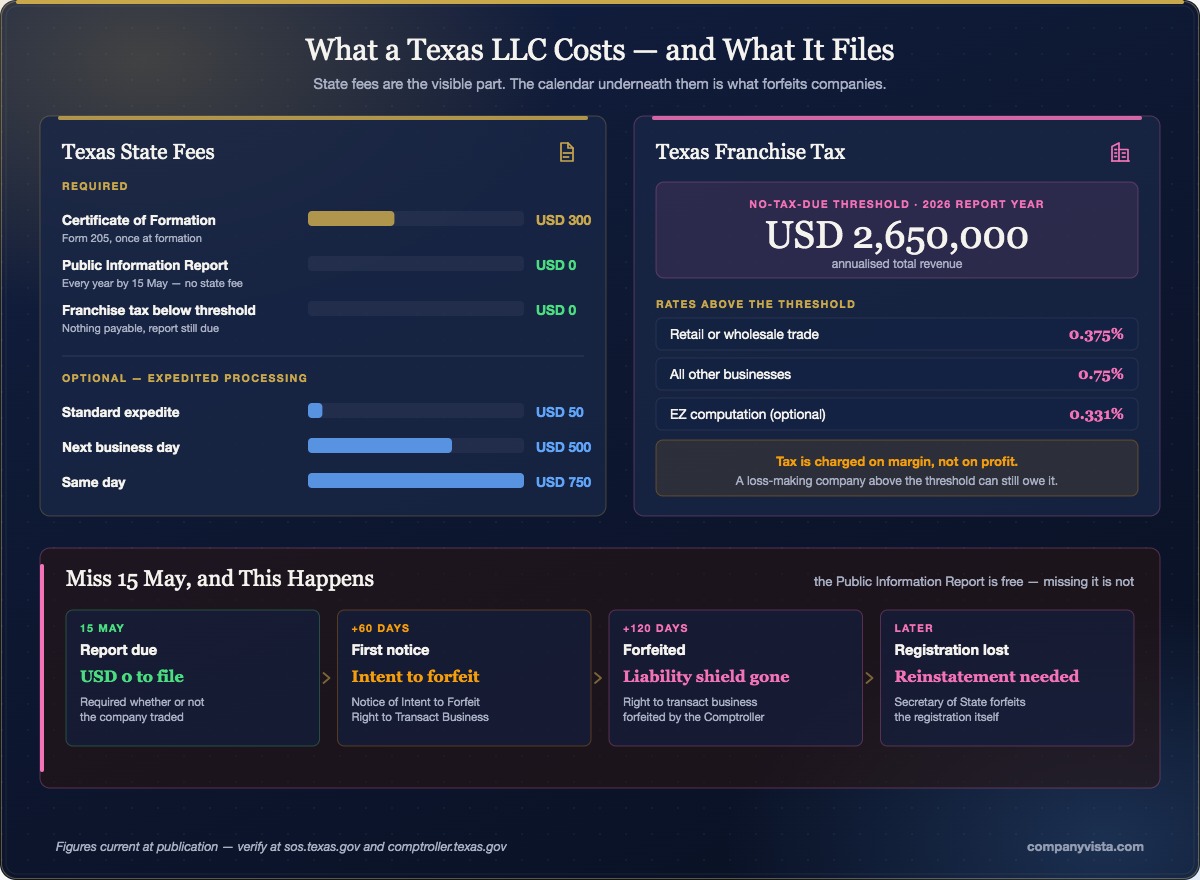
A Texas LLC is not the cheapest US entity to start. The headline is the USD 300 Certificate of Formation fee, which is high by US standards — several states charge under USD 100. What follows it is comparatively light, and the running cost of a Texas LLC is lower than the formation fee suggests.
| Item | Cost | When |
|---|---|---|
| Certificate of Formation (Form 205) | USD 300 | Once, at formation |
| Expedited processing — standard tier | USD 50 per document | Optional, at filing |
| Expedited processing — next business day | USD 500 per document | Optional, at filing |
| Expedited processing — same day | USD 750 per document | Optional, at filing |
| Public Information Report | No state fee | Annually, by 15 May |
| Franchise tax | None below the threshold | Annually, if above |
| Registered agent service | Recurring annual cost | Every year |
| Federal filings (Form 5472, tax return) | Professional fees | Every year |
State fees are set by Texas and change from time to time; the figures above were current at the time of writing and should be confirmed against the Secretary of State before you file. CompanyVista's own service fees are quoted in writing before any payment is taken, and our Texas formation page sets out what registering a US company here includes.
Texas Franchise Tax: The Threshold and the Trap
Every Texas LLC falls within the franchise tax regime, and almost none of them owe anything under it. Texas does not levy a corporate income tax. It levies a franchise tax, and the difference matters: franchise tax is calculated on margin, not on profit. A company can be loss-making and still owe it.
For the 2026 report year, the no-tax-due threshold is USD 2,650,000 in annualised total revenue. Below that figure, no franchise tax is payable. Above it, tax is calculated on taxable margin at:
- 0.375% for businesses primarily engaged in retail or wholesale trade
- 0.75% for all other businesses
- 0.331% under the EZ computation, an optional simplified method available to smaller filers
The threshold is generous, and the overwhelming majority of newly formed companies sit well below it. That is exactly where the trap is. Founders below the threshold conclude they owe nothing, which is correct, and then conclude they need file nothing, which is not.
The Report You File Even at Zero Revenue
Every Texas LLC files a Public Information Report with the Texas Comptroller each year, due by 15 May. There is no state fee for it. It is required whether the company traded or not, and whether any franchise tax is owed or not.
Older guidance on this is actively misleading, because the rules changed. The separate No Tax Due Report was discontinued from the 2024 report year. Companies below the threshold no longer file it — but they do still file the Public Information Report, and a founder reading a 2023 article can easily come away believing there is nothing to do at all.
The report also carries a consequence founders rarely anticipate: it is public. The managers or managing members named on it are on a searchable state record. For most businesses that is unremarkable, and for founders who chose a US entity partly for discretion it is a material difference from Wyoming or New Mexico.
Federal Obligations a Texas LLC Still Carries
Texas compliance is only half the calendar. Federal obligations attach to a Texas LLC because it is foreign-owned, not because it is in Texas. Every foreign-owned US LLC carries the same set, and they are indifferent to which state you chose.
- Form 5472 with a pro forma Form 1120, for a single-member Texas LLC owned by a non-US person. It is due even at zero revenue, cannot be filed electronically, and carries a USD 25,000 penalty per form per year. Our Form 5472 guide covers what counts as reportable and what to do about missed years.
- Form 1065 with Schedules K-1, if the Texas LLC has two or more members, along with any withholding obligations on foreign partners.
- An EIN, which every US entity needs before banking or payments are possible.
- Federal income tax, where the business has income effectively connected with a US trade or business. Whether yours does is a question of facts, not of state.
Texas LLC vs Wyoming and Delaware
| Texas | Wyoming | Delaware | |
|---|---|---|---|
| State filing fee | USD 300 | Low | Moderate |
| Annual state filing | Public Information Report, no fee | Annual report with a fee based on assets | Annual LLC franchise tax |
| State income tax | None | None | None on out-of-state income |
| Other state tax | Franchise tax above USD 2,650,000 | None | Flat annual LLC tax |
| Members on public record | Managers or managing members disclosed | Not collected | Not collected |
| Workers' compensation market | Competitive private market | Monopolistic state fund | Competitive private market |
| Suits staffing and recruiting | Yes — our default recommendation | No — insurance placement is the obstacle | As a holding company only |
| Suits venture fundraising | No — investors expect a C-Corp | No | Yes, as a C-Corp |
If the only variable is what a US LLC costs to run, a Texas LLC loses to Wyoming on day one and stays behind. If the business employs people, insures them and sells to US clients, the ranking reverses and the USD 300 stops being the point.
Mistakes Non-Residents Make in Texas
| Mistake | What it costs |
|---|---|
| Using a virtual address as the registered agent | Texas requires a physical street address at which the agent can be personally served, with written consent on file. A mailbox is a defective filing. |
| Assuming no franchise tax means no filing | The Public Information Report is due by 15 May regardless. This is the single most common Texas failure among non-resident owners. |
| Relying on pre-2024 guidance | The No Tax Due Report was discontinued from the 2024 report year. Articles written before that describe a filing that no longer exists and omit the one that does. |
| Choosing Texas purely for "no income tax" | Several cheaper states give the non-resident owner of a US company the same state-tax position. Texas earns its fee through operations, not through tax arbitrage. |
| Forming in Texas while operating elsewhere | Or the reverse. Operating in a state you did not form in means foreign qualification there — two agents, two fees, two calendars. |
| Expecting privacy | Managers and managing members appear on a public annual filing. If that matters, decide before formation, not after. |
| Treating state compliance as the whole job | A foreign-owned Texas LLC still files Form 5472 and a federal return, on their own calendar and at far higher penalties than anything Texas charges. |
| Skipping the operating agreement | Texas does not require one, but banks ask for it and a multi-member company without one has no agreed answer to any dispute. |
How CompanyVista Helps
We form Texas LLCs for non-resident founders end to end, and we form the same US company in every other state when Texas is not the right answer: name clearance, registered agent with a compliant Texas street address, the Certificate of Formation, the EIN by whichever route is open to you, the operating agreement, and Comptroller registration so the first annual report is not a surprise.
Afterwards, compliance and accounting support for your Texas LLC keeps the 15 May Public Information Report and the federal Form 5472 on one calendar rather than two, which is where most first-year companies come unstuck. Our team includes US-credentialed CPAs, IRS Enrolled Agents and Certified Acceptance Agents. We are a document filing, taxation and accounting firm and do not provide legal advice or insurance advice; where either is needed, we work alongside independent attorneys and licensed brokers.
A written quote is provided before any payment, normally within 4 to 24 hours. If a staffing business is what you are building, say so when you enquire — it changes the state recommendation, and occasionally we will tell you Texas is not the answer either.