Why the Best State to Form an LLC Differs for Non-Residents
Search for the best state to form an LLC and you will find hundreds of articles giving the same answer: form in your home state. For an American that advice is correct and it is nearly always the end of the discussion, because operating from California while incorporated in Wyoming means registering in California anyway and paying both.
You do not have a home state. There is no state you live in, no state where your desk sits, no state whose registration you are trying to avoid. That single fact removes the constraint that governs the answer for everyone else — and it is why the state you pick is genuinely a free choice, decided on cost, privacy and how easily you can open a bank account.
It also means most of the alarming content you will read about "the cheap state trap" when researching the best state to form an LLC does not apply to you. That trap is real, and it catches Americans constantly. It is not your problem.
What Actually Matters When You Form an LLC
Five things genuinely differ between states when you form an LLC as a non-resident.
- Formation fee. A one-off cost, and the smallest consideration on this list.
- Annual cost. This recurs for the life of the company and is where the real difference sits — the spread across popular states runs from zero to several hundred dollars a year.
- Privacy on the public filing. Whether member names appear on the state register.
- Banking recognition. How readily the platforms that onboard non-residents accept a company from that state. Rarely discussed and frequently decisive.
- Processing speed. Same-day in some states, several days in others.
Three things that do not differ, despite being widely marketed as though they do:
Federal tax. Identical in every state. Your federal position depends on whether income is effectively connected with a US trade or business, not on where you filed.
Form 5472. A foreign-owned single-member LLC files it wherever the company sits. USD 25,000 penalty, every state.
Liability protection. Broadly equivalent across the states discussed here. The differences that exist are of interest to litigators, not to a founder choosing where to file.
Best State to Form an LLC: Six States on Real Numbers
| State | Filing fee | Annual cost | Members public? | Best for |
|---|---|---|---|---|
| Wyoming | USD 100 | USD 60 | No | Almost every non-resident founder |
| New Mexico | USD 50 | None | No | Lowest cost, if banking is not urgent |
| Delaware | USD 110 | USD 300 | No | Only where a counterparty requires it |
| Florida | USD 125 | USD 138.75 | Yes | Presence in Florida, staffing |
| Texas | USD 300 | None below the threshold | Yes | Presence in Texas, staffing |
| Nevada | USD 425 | Around USD 350 | Yes | Rarely the right answer |
When you are deciding the best state to form an LLC in, read the annual column rather than the filing column. Over five years a Wyoming LLC costs roughly USD 400 in state fees and a Nevada LLC roughly USD 2,175. That gap buys you nothing.
What the Official Data Actually Shows
A word of caution before the numbers, because the question of the best state to form an LLC attracts confident charts that cannot be sourced.
No US state records the residency of company owners. There is no dataset showing how many LLCs non-residents formed in Wyoming, Delaware or anywhere else, because that information is never collected. Wyoming and New Mexico do not even collect member names — which is precisely why non-residents favour them, and precisely why the data cannot exist. If you see a chart ranking states by non-resident formations, it is an estimate presented as a fact.
What is published, by the Delaware Division of Corporations in its statutory annual report, is the total volume of formations. It is the only state that reports at this level of detail.
Three things worth drawing from this. Delaware formations run to roughly a quarter of a million entities a year, and the state held over 2.1 million active entities at the end of 2024. Around 73% of what Delaware registers are LLCs rather than corporations — so the Delaware brand people associate with public companies is, by volume, overwhelmingly an LLC register. And its genuine dominance is at the top end: 66.7% of Fortune 500 companies and 81.4% of US IPOs in 2024.
That last figure is the honest case for Delaware, and it is also the honest case against it for most readers of this guide. Delaware is unmatched for companies heading towards institutional investment and public markets. If that is not your path, you are paying for infrastructure built for someone else.
What we see across our own formations
Official data cannot tell you where non-residents file. Our own records can, for our own clients, which is a narrower but more relevant picture than any government statistic.
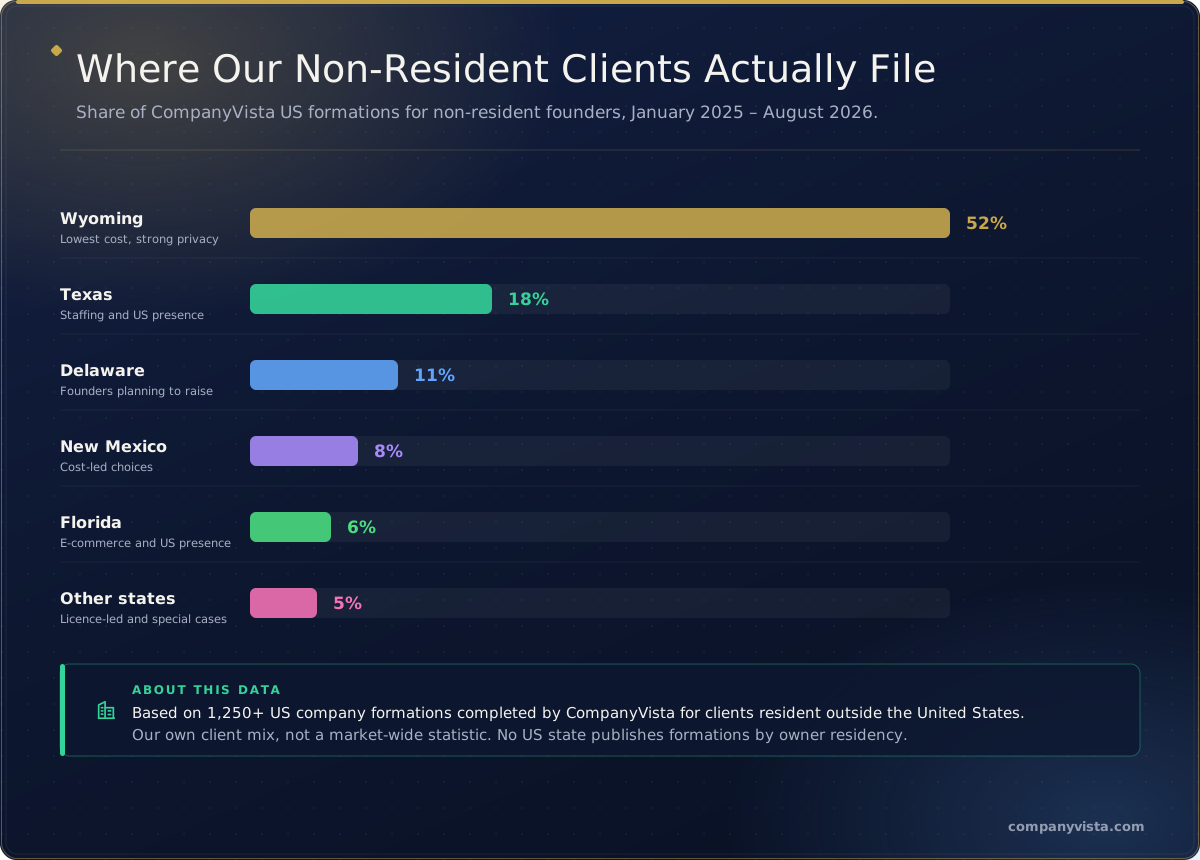
Three patterns are worth drawing out, because they match the reasoning in the rest of this guide rather than contradicting it.
Wyoming dominates, and it is not close. That is what you would expect once the brand effect is stripped away: the lowest annual cost, no member names on the public filing, and banking platforms that recognise it readily.
Texas comes second, which surprises people. It is not a cost decision — Texas costs USD 300 to file against Wyoming's USD 100. It is a presence decision. Staffing and recruitment businesses cannot practically use Wyoming, and founders with US staff or inventory are better off registering where they actually operate than registering in Wyoming and qualifying in Texas anyway.
Delaware is a minority, and it clusters. The founders who choose it are overwhelmingly those planning to raise, which is the one case where it is genuinely the right answer. Founders who arrive convinced of Delaware for credibility reasons usually change their minds once the annual cost difference is in front of them.
New Mexico and Florida make up the tail: New Mexico chosen on price by founders for whom price is the binding constraint, Florida where there is a genuine Florida connection.
Wyoming publishes far less. Its Secretary of State reports strong growth in LLC registrations in recent years, but not in the comparable annual format Delaware uses, so we have not charted it rather than mixing sources of different quality.
Wyoming: The Best State to Form an LLC for Most Founders
Wyoming is the best state to form an LLC for most of the founders we work with, and the reasons are unglamorous but decisive.
USD 100 to file and USD 60 a year to maintain. No state income tax and no franchise tax — and the absence of income tax is written into the Wyoming Constitution rather than being a policy that could change with a budget. Member names do not appear on the Articles of Organization. Online filings are processed immediately. Banking recognition is strong, which matters more than any of the above.
Two things to know before you file. The annual report is due on the first day of your anniversary month, not a fixed date, and if it is more than 60 days late the LLC is administratively dissolved automatically with no further warning. And Wyoming's privacy has a limit worth understanding: the name of whoever files the annual report goes on the public record permanently.
Both points, and the rest of the detail, are covered in our full Wyoming LLC guide.
Delaware: Only If You Are Raising
Delaware has the strongest brand in US company formation, and it is the state most often suggested when founders ask about the best state to form an LLC. For non-resident founders that brand is the problem. It is sold constantly to people who will never use anything it offers.
A Delaware LLC costs USD 300 a year against Wyoming's USD 60 — five times the cost for identical federal tax treatment, identical filing obligations and no additional benefit. Delaware's reputation belongs to its corporate law and its Court of Chancery, which matter to a company with institutional investors and a board, not to a single-member LLC run from Dubai.
Where Delaware genuinely is the right answer is a C-Corporation raising US venture capital. US funds are structurally built to invest in Delaware C-Corps, and converting later costs real money and real time. If that is your plan, read our Delaware C-Corp guide — and pay attention to the franchise tax section, because the default calculation method bills a typical startup around USD 85,000.
New Mexico: Cheapest, With One Catch
Judged purely on price, New Mexico is the best state to form an LLC in: USD 50 to file, no annual report and no annual fee at all. Member names are not published. Over five years it costs USD 50 in total state fees against Wyoming's USD 400.
The catch is banking. Several of the fintech platforms that onboard non-resident founders are slower with New Mexico entities than with Wyoming ones, and some are more likely to ask additional questions. That is a commercial pattern rather than a rule, and it changes over time — but the practical effect is that saving USD 60 a year can cost you weeks on the step that actually gates your business.
New Mexico is a reasonable choice if cost is the binding constraint and you are not in a hurry to bank. If your priority is being operational quickly, Wyoming's USD 60 is cheap insurance.
Texas and Florida: When You Have Presence
Texas and Florida become the best state to form an LLC in for one specific reason: you have or will have something physically in that state — staff, an office, inventory in a warehouse.
If that is true, forming in Wyoming does not avoid the second state. You would register in Wyoming and then register again in Texas as a foreign LLC, paying both. Forming directly in the state where you operate is simpler and cheaper.
Texas costs USD 300 to file with no annual report fee, though a franchise tax report is filed each year and tax becomes payable above a revenue threshold in the millions. Florida costs USD 125 to file with a USD 138.75 annual report. Both publish member or manager information, so neither offers Wyoming's privacy.
Nevada: The One Most Often Oversold
Nevada is marketed as the best state to form an LLC harder than any other, on privacy and tax grounds, and for a non-resident founder it is close to indefensible on the numbers.
Formation costs around USD 425. Every year thereafter you pay a USD 150 annual list fee and a USD 200 state business licence — both mandatory, giving roughly USD 350 a year. That is close to six times Wyoming's annual cost.
What do you get for it? No state income tax, which Wyoming also has. Privacy, which Wyoming does better because Nevada publishes manager and member information. A reputation for asset protection that is genuinely strong in the abstract and largely irrelevant to a founder abroad with no Nevada assets to protect.
Nevada earns its cost for businesses actually operating in Nevada. For everyone else it is a marketing success rather than a structural one.
Foreign Qualification: The Rule That Changes Everything
Foreign qualification is the rule that makes state choice complicated for Americans, and the one you need to understand well enough to know whether it applies to you.
If a company carries on business in a state other than the one it was formed in, it must register there as a foreign LLC — a second registration, a second annual fee and a second set of filings, every year. "Foreign" here means from another state, not from another country.
What generally triggers it is physical presence: an office, employees, inventory held in that state, or a repeated physical presence conducting business. What generally does not trigger it is having customers there, shipping to them, or running a website they use.
Two situations do trigger foreign qualification for non-residents. Inventory in a US warehouse — including Amazon FBA fulfilment centres — can create presence in the states where that stock sits. And hiring a US-based employee creates presence in the state where they work. Both are worth advice before you scale rather than after, because the registration obligation is retrospective.
What Does Not Change, Whichever State You Pick
A short section, but it settles a lot of anxiety about choosing the best state to form an LLC in.
- Form 5472. A foreign-owned single-member LLC files it with a pro forma Form 1120 every year, due 15 April, even with zero revenue. USD 25,000 penalty. Identical in all fifty states. See our Form 5472 guide.
- Your EIN. Federal, issued by the IRS, unaffected by state. Obtainable without an SSN.
- Federal income tax. Turns on whether income is effectively connected with a US trade or business, not on where you filed.
- Tax at home. Your country of residence taxes you under its own rules. A US LLC changes where you invoice from, not who you are for tax purposes.
- Registered agent. Required in every state. You cannot be your own from abroad.
- Banking requirements. Every platform wants the same documents wherever you formed.
If you pick the wrong state to form an LLC in, you have made a modest and reversible cost error. If you miss Form 5472, you have a USD 25,000 problem. The second deserves far more of your attention than the first.
Best State to Form an LLC: How to Choose in Five Minutes
| Your situation | Form in |
|---|---|
| Online business, no US presence, want it done properly | Wyoming |
| Raising US venture capital, now or within two years | Delaware — as a C-Corporation, not an LLC |
| Cost is the binding constraint, banking not urgent | New Mexico |
| Staffing or recruitment business | Texas, Florida or Georgia — not Wyoming |
| Employees or an office in a specific state | That state |
| Amazon FBA with US inventory | Wyoming, with advice on warehouse-state presence |
| A counterparty requires Delaware in writing | Delaware |
| Someone told you Nevada | Wyoming — ask them why not |
Mistakes Non-Residents Make Choosing a State
| The mistake | What it costs you |
|---|---|
| Reading advice on the best state to form an LLC written for Americans | "Form in your home state" is correct for them and meaningless for you. Most of the state-choice content online assumes a US resident. |
| Comparing filing fees instead of annual fees | The filing fee is paid once. The annual fee recurs forever. Wyoming and Nevada differ by USD 25 to form and roughly USD 290 every year. |
| Choosing Delaware for credibility | USD 240 a year more than Wyoming for a feeling. No bank, processor or customer treats a Wyoming LLC as lesser. |
| Choosing New Mexico purely on price | Saving USD 60 a year is a poor trade against a slower bank account application, which delays the thing that actually matters. |
| Choosing Wyoming for a staffing business | Workers' compensation and E&O cover are difficult without operational presence in the state. |
| Ignoring US inventory or US staff | Both can create presence in that state and trigger foreign qualification, retrospectively. |
| Believing a state can reduce your federal tax | No state affects federal tax. Any adviser suggesting otherwise is describing something that does not exist. |
| Agonising over the state and missing Form 5472 | The state decision is a modest reversible cost. Form 5472 is USD 25,000 a year. |
How CompanyVista Helps
CompanyVista is a document filing, taxation and accounting firm — not a law firm. Our team brings together US-credentialed CPAs, IRS Enrolled Agents, Certified Acceptance Agents, chartered accountants and filing specialists, with offices in Noida NCR and Albuquerque, New Mexico. Where a matter genuinely requires legal advice we work alongside independent attorneys in the relevant jurisdiction rather than offering it ourselves.
We register companies in all fifty US states, including Wyoming, and handle the registered agent, the EIN, business banking coordination and the annual state and federal filings. US formation packages start at USD 299 plus state fees, with the price shown before any payment.
Most usefully at this stage: tell us what the business does and where your customers are, and we will tell you the best state to form an LLC for your situation — including when the answer is not the one you were expecting, and when a US entity is not the right structure at all.