What a Nominee Director Actually Is
A nominee director is a person resident in a particular country who is appointed to your company's board because the law of that country requires at least one director to live there.
The word "nominee" describes the commercial arrangement, not a separate legal status. In law, a nominee director is a director. Same statutory duties, same fiduciary obligations, same personal exposure. There is no reduced category of directorship that carries the title without the responsibility.
That single point explains almost everything else about how these services work — why providers require an indemnity, why they take a security deposit, why they insist on knowing what your business does, and why any provider willing to sign without asking questions should worry you rather than reassure you.
Why Some Countries Require a Resident Director
The requirement is not about control or protectionism. It is about enforceability.
A company is a legal person, and when it breaches a statute, fails to file, or leaves tax unpaid, the regulator needs a natural person within its jurisdiction who can be served, questioned, fined and if necessary prosecuted. A board composed entirely of people living overseas leaves the regulator with no practical means of enforcement.
So countries that impose a resident director requirement are, in effect, requiring you to provide someone they can hold accountable locally. Understanding that makes the rest of the arrangement intelligible: the nominee is the person the state will come to first, which is precisely why the role carries real risk and real cost.
Which Jurisdictions Require a Resident Director
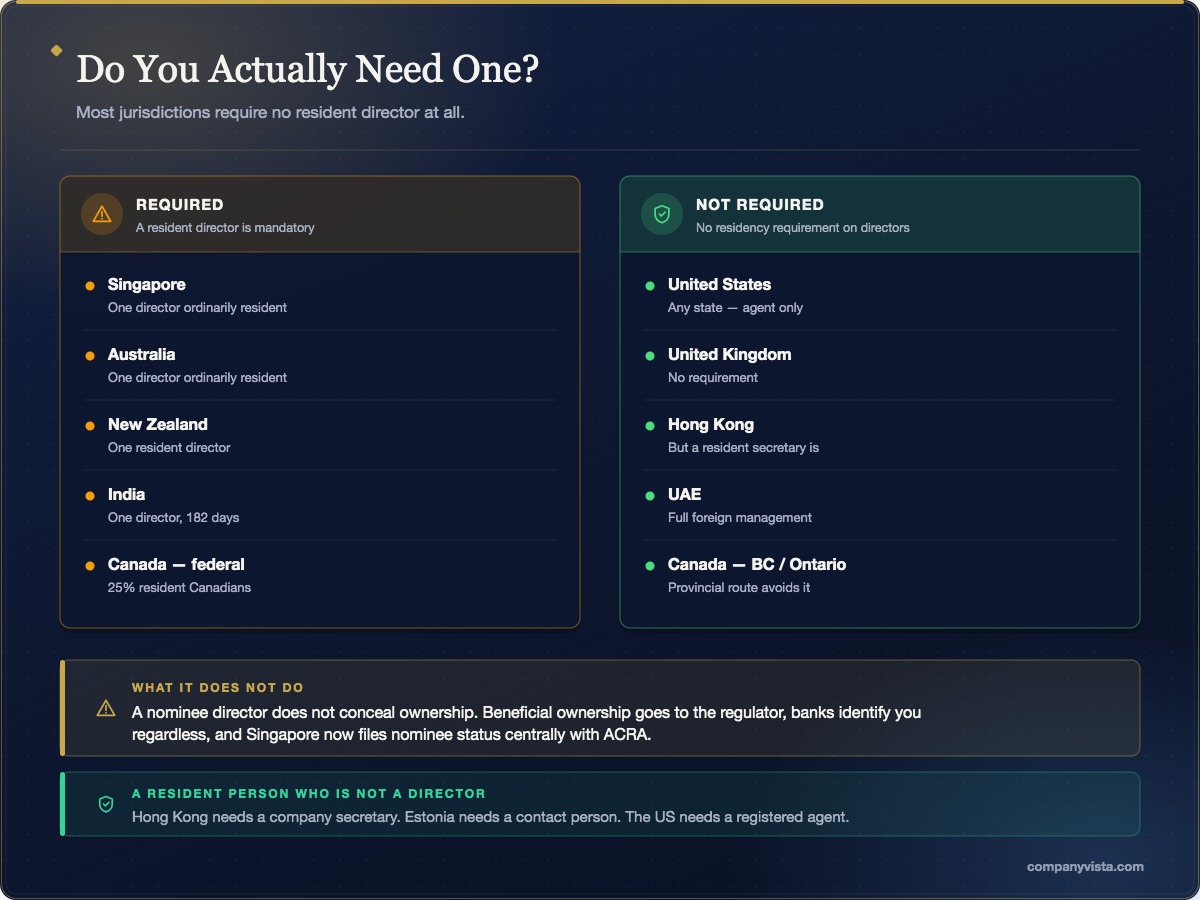
This is the table that answers the question for most readers.
| Jurisdiction | Resident director required? | Detail |
|---|---|---|
| Singapore | Yes | At least one director ordinarily resident in Singapore, at all times. Must be a natural person — corporate directors are not permitted. |
| Australia | Yes | A proprietary company needs at least one director ordinarily resident in Australia. All directors also need a Director Identification Number. |
| New Zealand | Yes | At least one director resident in New Zealand, or resident in Australia and also a director of an Australian company. |
| India | Yes | At least one director resident in India for 182 days or more in the financial year. |
| Canada — federal (CBCA) | Yes | 25% of directors must be resident Canadians, or at least one where the board has fewer than four. |
| Canada — BC, Ontario, Alberta | No | No residency requirement. Ontario repealed its rule in 2021. |
| Hong Kong | No director | But a company secretary resident in Hong Kong is mandatory, and a sole director cannot fill that role. |
| United Kingdom | No | No residency requirement for directors or shareholders. |
| United States | No | No state imposes one. See the section below. |
| UAE | No | Free zone and most mainland structures permit full foreign ownership and management. |
| Estonia | No | But a local contact person is required where no board member resides there. |
Two patterns are worth noticing. Several jurisdictions that do not require a resident director still require a resident someone — a Hong Kong company secretary, an Estonian contact person, a US registered agent. These are different roles with different risk profiles, and they should not be conflated.
And within a single country the answer can differ by which register you use. A Canadian federal corporation needs resident Canadian directors; a British Columbia or Ontario corporation does not. Choosing the provincial route avoids the requirement entirely, which is usually cheaper and simpler than solving it.
What a Nominee Director Does Not Do
This section matters more than any other, because it is where this industry is least honest.
A nominee director does not conceal who owns or controls your company. Not from the regulator, not from your bank, not from the tax authority, and increasingly not from the public register either.
The nominee's own name is on the public register of directors. Their identity is published — yours is recorded separately as beneficial owner.
Banks identify beneficial owners as a condition of opening an account. No bank opens a business account without knowing who ultimately controls it.
Nominee status itself is now registered in some jurisdictions. Singapore moved nominee director and shareholder particulars into a central register filed with ACRA under amendments taking effect in 2025 — previously these were kept privately at the registered office.
What a nominee director legitimately provides is compliance with a residency requirement. That is the entire product. It is a valuable and perfectly proper service, and it is not a privacy arrangement.
If a provider markets nominee director services on the basis that your name will not appear anywhere, they are either misunderstanding the law or misrepresenting it. Either should end the conversation, because you would be relying on them to keep you compliant.
The US Nominee Director Myth
Worth a section of its own, because we are asked about it constantly and the answer is unambiguous.
No US state requires a resident director, manager or member. Not Wyoming, not Delaware, not any of the other forty-eight. A non-resident can own 100% of a US LLC or corporation and be its sole manager or director, without a visa and without ever visiting.
So a nominee director for a US company solves a problem the law does not create. Any provider selling one is selling something unnecessary.
Confusion usually comes from three places: conflating the registered agent with a director; assuming a US company needs a local person to open a bank account, which it does not; or being sold a privacy benefit that, as covered above, does not exist. Our guide to choosing a US state covers what you genuinely need.
The Nominee Carries Real Legal Duties
Understanding what the nominee is actually taking on explains the cost, the paperwork and the questions they will ask you.
A nominee director owes the company the full set of directors' duties: to act honestly and in the company's best interests, to exercise reasonable care and diligence, to disclose conflicts of interest, and to ensure statutory filings are made. In Singapore these sit in the Companies Act, enforced by ACRA; equivalents apply in Australia, New Zealand, India and Canada.
Three consequences of those duties follow that founders rarely anticipate.
- Being a nominee is not a defence. A director who says they were only holding the seat and took instructions from the owner has described a breach of duty, not an excuse for one. Directors are required to exercise independent judgement.
- Your indemnity does not bind the regulator. A Director Services Agreement can require you to reimburse the nominee, and it should. It cannot stop a regulator fining or disqualifying them, or a creditor pursuing them.
- They can carry liability for your filings. Late accounts, unpaid tax, unfiled returns — the nominee is the accountable person in-country, and that liability is personal.
That is why a serious provider will ask what your business does, who your counterparties are and where your money comes from, and will decline businesses they judge too risky. A provider who does not ask is not protecting themselves, which means they will not protect you either.
What Control You Keep
The common fear is that appointing a nominee hands someone else your company. Properly structured, it does not.
| You retain | The nominee has |
|---|---|
| 100% of the shares — the nominee holds no equity | A board seat, and nothing else by default |
| Full operational control of the business | No authority over day-to-day operations |
| Bank account signing authority | No ability to move funds without your written approval |
| The right to remove them as shareholder | No security of tenure beyond the agreement |
| All profit and distributions | A fixed annual fee, not a share of profit |
| Ownership on the beneficial owner register | Their name on the public director register |
The protections that make this hold are contractual, and they have to be written properly. The essential ones are that the nominee cannot open or close accounts, borrow, transfer funds, issue shares or bind the company to contracts without your written authorisation, together with a pre-signed undated resignation letter you can use if the relationship breaks down.
Ask to see these terms before engaging. A provider who cannot show you the agreement in advance is not one to appoint.
The Director Services Agreement
This document is the whole arrangement. Read it rather than skimming it.
Note the last line. Your obligations are real. The nominee is exposed to penalties arising from filings you fail to provide information for, so agreements reasonably allow them to resign if you stop cooperating. That is not a trap — it is the natural consequence of someone carrying liability for a company they do not run.
How to Choose a Provider
- Do they ask what your business does? The most important signal. A provider who accepts any business without diligence is carrying risk they have not priced, and will exit abruptly when it materialises.
- Is the nominee a real, identifiable person resident in that country? Singapore does not permit corporate directors at all, and a Singapore appointment must be a natural person ordinarily resident there.
- Will they show you the agreement before you pay?
- Is the security deposit refundable, and on what terms?
- What happens if they resign? Your company is non-compliant from that moment. Ask about notice and replacement.
- Do they handle the filings too? A nominee who is exposed to your compliance failures but does not control your filings is a poor structure.
- Are they honest about what it does not do? A provider implying concealment is telling you they will mislead you when it suits them.
Replacing the Nominee Later
Many founders treat the nominee as temporary, which is often the right approach. Once you obtain local residency or an employment pass, you can usually serve as your own resident director and the arrangement ends.
The sequencing matters more than people expect. A company is non-compliant from the instant it has no qualifying resident director — there is no grace period in most jurisdictions. So the incoming director must be appointed before or at the same moment the outgoing one ceases, filed on the same day.
Plan the handover as a single transaction rather than two events. Also settle in advance what happens to the security deposit, and give the provider proper notice; agreements typically require a notice period and most will not release the deposit until outstanding filings are clear.
What Nominee Director Services Cost
Costs have two components and both should be quoted before you commit.
An annual fee for the appointment, reflecting the liability the nominee is taking on. It varies by jurisdiction and by the risk profile of your business — a straightforward consultancy and a high-volume trading company are not the same engagement, and honest providers price them differently.
A refundable security deposit, held against the nominee's exposure and returned when they cease to act and outstanding matters are clear. This is standard practice, not a red flag. A provider taking no deposit at all has either not understood their exposure or does not intend to be there when it crystallises.
These jurisdictions sit outside the small group where we publish fixed pricing, so we do not quote a figure here. We provide a written quote covering both components before any payment is taken, together with the agreement itself, so you can read the terms before deciding.
One comparison worth making: in several cases the cheaper answer is to avoid the requirement entirely. A British Columbia or Ontario corporation needs no resident director where a federal one does. That is a better outcome than any price you will be quoted.
Mistakes Founders Make
| The mistake | What it costs you |
|---|---|
| Buying a nominee director for a US company | No US state requires one. You are paying for a role the law does not create, often several hundred dollars a year indefinitely. |
| Expecting the arrangement to hide ownership | It does not. Beneficial ownership goes to the regulator, banks identify you anyway, and in Singapore nominee status is now centrally filed with ACRA. |
| Incorporating federally in Canada by default | A federal corporation needs resident Canadian directors. BC or Ontario does not — the requirement disappears rather than needing to be solved. |
| Choosing the provider who asks fewest questions | They have not priced their risk. They will resign when it materialises, and your company is non-compliant that day. |
| Not reading the Director Services Agreement | The restrictions, indemnity, deposit terms and exit mechanics are the entire product. Skimming it is skimming the thing you bought. |
| Assuming the indemnity protects the nominee fully | It binds you and them. It does not bind a regulator, a court or a creditor. |
| Letting the nominee resign before a replacement is appointed | The company is non-compliant from that instant. Appointments must be sequenced on the same day. |
| Confusing a registered agent or company secretary with a director | Different roles, different duties, very different costs. Hong Kong needs a secretary, not a director; the US needs an agent, not a director. |
How CompanyVista Helps
CompanyVista is a document filing, taxation and accounting firm — not a law firm. Our team brings together US-credentialed CPAs, IRS Enrolled Agents, Certified Acceptance Agents, chartered accountants and filing specialists, with offices in Noida NCR and Albuquerque, New Mexico. Where a matter genuinely requires legal advice we work alongside independent attorneys in the relevant jurisdiction rather than offering it ourselves.
We provide nominee and resident director services across the jurisdictions that require them, including Singapore, Australia, New Zealand and Canada, always with a Director Services Agreement setting out the restrictions, the indemnity, the deposit terms and the exit mechanics in writing. We also handle the statutory filings and banking coordination, because a nominee exposed to compliance failures they do not control is a badly built structure.
Most usefully: we will tell you when you do not need one. A significant share of the enquiries we receive concern jurisdictions with no residency requirement at all, and saying so costs us an engagement and earns a client.