Why Compliance Doesn't End at Formation
Most founders treat LLC formation as the finish line. You file the Articles of Organization, get your EIN, open a bank account, and move on to actually running the business. But a US LLC isn't a one-time paperwork exercise — it's an entity with ongoing legal obligations to the state that formed it and to the IRS, and those obligations don't pause just because the owner lives on another continent. Miss them, and the consequences range from late fees to the state administratively dissolving your company to a federal penalty that starts at $25,000 for a single missed form. None of this is designed to be complicated on purpose — it's just that the responsibility for tracking it falls entirely on you, and nobody sends a friendly reminder before the damage is done.
This checklist walks through the recurring compliance items every foreign-owned US LLC needs to track, roughly in the order they tend to come due across a typical year. Deadlines and fees vary by state and by your LLC's fiscal year, so treat the specifics here as a framework, not a substitute for checking your own state's rules.
1. Registered Agent & Registered Address
Every US state requires an LLC to maintain a registered agent — a person or company with a physical street address in the state of formation, available during business hours to receive legal notices, service of process, and official state correspondence on the company's behalf. If you don't live in the US, you can't be your own registered agent, which is why this is almost always an outsourced, paid service renewed annually.
This is easy to forget precisely because it works silently in the background — until it lapses. If your registered agent service expires and isn't renewed, the state can flag your LLC as not in good standing, and in more serious cases, administratively dissolve it. Since this is typically the very first service a founder sets up when forming the LLC, it's also usually the first one to quietly expire a year later if nobody's tracking the renewal date.
What to track
The renewal date (usually 12 months from your original registration), and confirmation that your registered address is still active — some providers require you to actively renew rather than auto-billing, so a lapsed card can silently break this.
2. State Annual Report / Franchise Tax Filing
Separately from the registered agent, most states require an annual (or in some states, biennial) report to keep your LLC's information current on public record — company name, registered agent, sometimes member/manager details. Some states bundle this with a franchise tax or annual fee; others (like Wyoming) keep it simple with a flat report and modest fee. The filing itself is usually short, but missing it is treated seriously: most states impose a grace period followed by escalating late penalties, and eventually administrative dissolution if it's ignored long enough.
Because the specific due date, form, and fee vary considerably by state — and because some states have no annual report requirement at all — this is one of the first things worth confirming directly with your state's Secretary of State office when you form the entity, so you know exactly what your company's calendar looks like from day one.
3. Federal Tax Filing: Form 5472 + Pro Forma 1120
This is the item with the highest stakes and the lowest awareness among foreign founders, so it deserves the most space here. If your US LLC is a single-member LLC owned by a non-US person (or a foreign entity), and it hasn't elected to be taxed as a corporation, the IRS still requires you to file Form 5472 alongside a pro forma Form 1120 every year — even if the LLC had zero income, zero activity, and zero US tax owed.
This requirement exists purely for information-reporting purposes: the IRS wants visibility into transactions between the LLC and its foreign owner (capital contributions, loans, reimbursements, etc.), regardless of whether any of it is taxable. Founders who assume "no income means no filing obligation" are, unfortunately, one of the most common groups to get caught out by this — the filing requirement is completely independent of profitability.
The penalty is not small
Failing to file Form 5472 on time carries an initial penalty of $25,000, and it can increase if the failure continues after the IRS sends notice. This applies per form, per year — it is one of the few compliance penalties in this checklist that isn't proportional to the size of your business.
The filing deadline generally follows the corporate tax deadline (mid-April for calendar-year entities, with an extension available), but because this isn't a form most general accountants outside the US are familiar with, it's worth working with someone who specifically handles foreign-owned US entity compliance rather than a generic bookkeeper.
4. Beneficial Ownership Information (BOI) Reporting
As part of the Corporate Transparency Act, most US LLCs are required to file a Beneficial Ownership Information report with FinCEN (the Financial Crimes Enforcement Network), disclosing who ultimately owns or controls the company. Newly formed entities generally need to file this shortly after formation, and any change to beneficial ownership information — a new member, a change of address, a new managing member — triggers an obligation to file an updated report. Given that this requirement and its enforcement posture have shifted more than once since it was introduced, foreign founders should confirm current BOI filing status directly rather than assuming last year's rule still applies unchanged.
5. ITIN and Personal Filing Obligations
If you, as a foreign owner, ever need to file a US tax return personally (which can depend on how your LLC is taxed and whether you have US-source income), you'll need an Individual Taxpayer Identification Number (ITIN) if you're not eligible for a Social Security Number. ITIN processing through the IRS can take a meaningful amount of time, particularly during peak filing season, so this is not something to start scrambling for the week before a deadline — if you know you'll need one, it's worth beginning the application process well in advance.
| Compliance Item | Who It Applies To | Typical Frequency |
|---|---|---|
| Registered Agent Renewal | Every US LLC | Annual |
| State Annual Report | Every US LLC (varies by state) | Annual or biennial |
| Form 5472 + Pro Forma 1120 | Foreign-owned single-member LLCs | Annual, with tax deadline |
| BOI Report | Most LLCs (on formation and on ownership change) | As triggered |
Building a Compliance Calendar That Actually Works
The common thread across everything above is that none of these obligations announce themselves. The state doesn't email you a friendly reminder before your registered agent lapses; the IRS doesn't send a heads-up before the Form 5472 deadline passes. The founders who stay compliant without stress are almost always the ones who've built (or outsourced) a simple calendar tracking each renewal date the moment the LLC is formed, rather than trying to reconstruct the timeline from memory a year later.
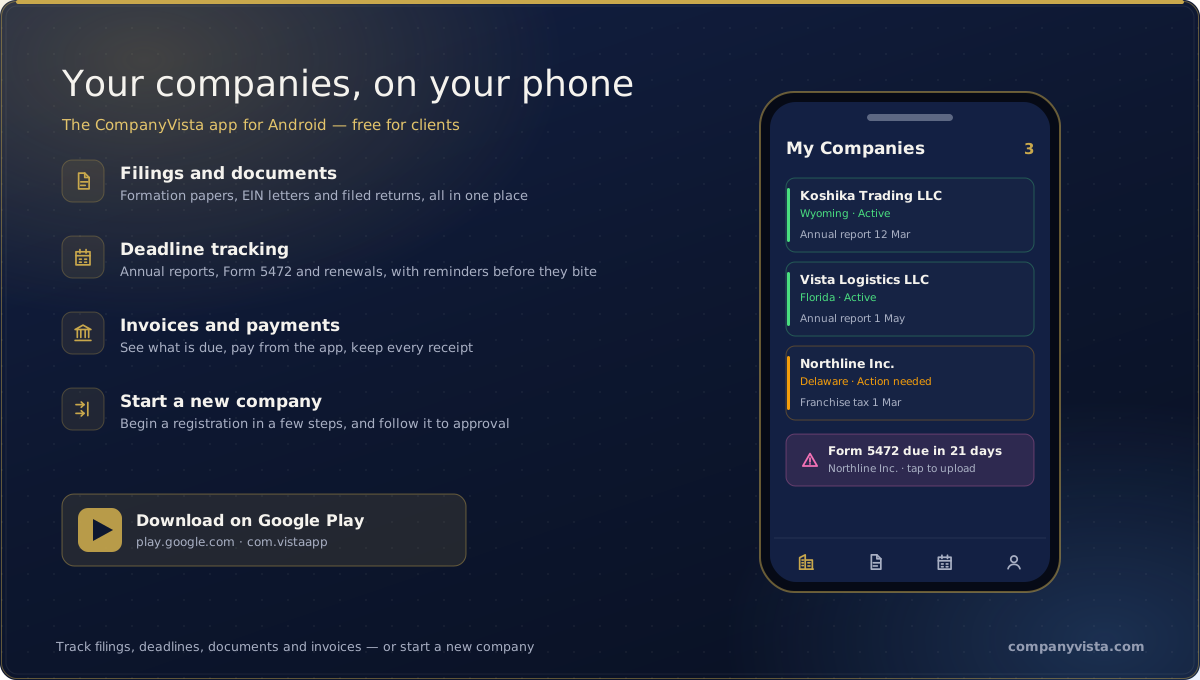
If you'd rather not track four separate deadlines across two governments while also running your actual business, that's precisely the gap a managed compliance service is built to close — registered agent renewal, annual report filing, and federal tax coordination handled on a single calendar, with reminders sent before anything is due rather than after it's missed.