
Why Non-Residents Register Companies in Canada
Canada company registration appeals to founders for reasons that have little to do with tax and a great deal to do with credibility and access.
A Canadian corporation is well regarded internationally, sits inside USMCA for North American trade, gives you a stable common-law legal system, and carries none of the reputational baggage that some low-tax jurisdictions attract. For founders selling into North America, it opens doors that an offshore entity does not. For those with an eye on immigration, a Canadian operating business is a plausible foundation for later pathways — though incorporating alone confers no status whatsoever.
Where this guide differs from most is that it deals directly with the two things that decide whether a Canadian company is right for you: the resident director rule, which varies by jurisdiction and is widely reported out of date, and the corporate tax position, which is materially worse for non-resident owners than the headline figures suggest.
Can a Non-Resident Register a Company in Canada?
Yes, and more easily than most people expect.
There is no citizenship or residency requirement for shareholders anywhere in Canada. You can own 100% of a Canadian corporation from abroad. There is no requirement to visit Canada to incorporate, no minimum capital, and no Canadian visa needed.
Directors are where jurisdictions differ, and that is the whole of the decision. Several provinces impose no residency requirement on directors at all, which means a board composed entirely of non-residents is perfectly valid. Others, and the federal regime, require a proportion of the board to be resident Canadians.
What every Canadian corporation needs regardless is a registered office address in the province of incorporation. This must be a real address in that province where documents can be served — not your address abroad, and not a PO box.
The Resident Director Rule, Province by Province
This is the single most misreported fact about Canadian incorporation, because Ontario changed its position in 2021 and a large amount of published guidance was never updated.
| Jurisdiction | Resident director required? | Detail |
|---|---|---|
| British Columbia | No | No residency requirement has ever applied. A board of entirely non-residents is valid. |
| Ontario | No | Repealed with effect from 5 July 2021. Much older guidance still says 25% — that is out of date. |
| Alberta | No | No residency requirement. |
| Quebec, New Brunswick, Nova Scotia, PEI | No | No residency requirement. |
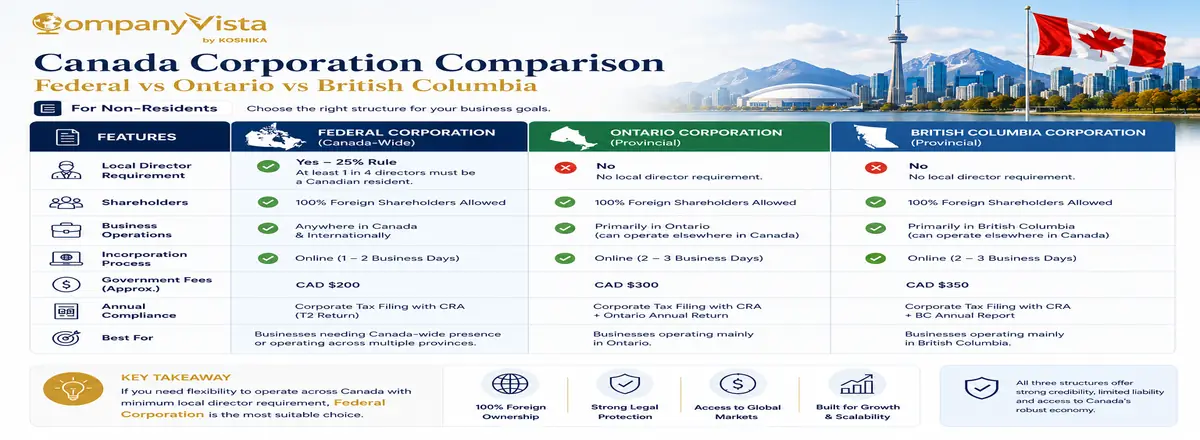
| Federal (CBCA) | Yes | At least 25% of directors must be resident Canadians. Where the board has fewer than four, at least one must be. |
| Manitoba, Saskatchewan, Newfoundland & Labrador | Yes | Same 25% or one-director threshold as the federal rule. |
A "resident Canadian" means a Canadian citizen or permanent resident who is ordinarily resident in Canada. It is a question of fact, not of paperwork, and appointing someone who does not genuinely meet the test does not satisfy the rule.
BC vs Ontario vs Federal Incorporation
For a non-resident, the practical choice is between British Columbia and Ontario. Federal incorporation is usually the wrong answer, and it is worth understanding why before anyone sells it to you on the strength of the word "federal".
| Factor | British Columbia | Ontario | Federal (CBCA) |
|---|---|---|---|
| Resident director | Not required | Not required | Required |
| Government filing fee | ~CAD 350 | ~CAD 300 | ~CAD 200 online |
| Filings to maintain | One | One | Two — federal plus a province |
| Name protection | Provincial | Provincial | Canada-wide |
| Registered office | Must be in BC | Must be in Ontario | Must be in a province |
| Suits | Pacific and Asia-facing business | Toronto corridor, most services | National brands with a Canadian director |
Federal incorporation is a double filing. A CBCA corporation still has to register extra-provincially in whichever province it actually operates in, so you end up with two registrations, two sets of fees and two annual returns — plus the resident director requirement. Its genuine advantage is nationwide name protection, which matters if you are building a brand you intend to use coast to coast. For most non-resident founders, it is not worth the cost.
Between the two provinces, the honest answer is that neither is meaningfully better on paper. Choose by where your customers, staff or warehousing will actually be.
The CCPC Trap: Why the 9% Rate Is Not for You
If you take one thing from this guide, take this. It is the most consequential fact about Canada company registration for non-residents, and it is almost never mentioned in guides aimed at overseas founders.
Canada's celebrated small business tax rate — 9% federal on the first CAD 500,000 of active business income — is available only to a Canadian-Controlled Private Corporation. The definition of a CCPC explicitly excludes any corporation controlled, directly or indirectly, by non-residents.
So if you own your Canadian company from abroad, it is not a CCPC. It cannot claim the small business deduction. It pays the general rate instead.
Two further points worth knowing. The test is applied at the corporation's year end, so a change of control late in the year can strip CCPC status for the whole of that year. And control includes de facto control, not merely shareholding — so structures designed to place nominal Canadian ownership over genuine foreign control do not achieve what they appear to.
Corporate Tax You Will Actually Pay
Setting CCPC status aside, the arithmetic is straightforward. The federal general rate is 15%, and each province adds its own general rate on top.
| CCPC (Canadian-controlled) | Your company (non-resident controlled) | |
|---|---|---|
| Federal rate | 9% on first CAD 500k | 15% on all active income |
| Ontario provincial | Low single digits | 11.5% |
| Combined — Ontario | Around 12% | Around 26.5% |
| Combined — British Columbia | Around 11% | Around 27% |
| Annual return | T2 | T2 |
Roughly 27% is not a bad rate internationally — it sits below several European jurisdictions and is broadly comparable to a US C-Corporation once state tax is added. The problem is only ever expectation. Founders who chose Canada on the strength of a "9% small business rate" headline are the ones who feel misled, and they were, by whoever quoted it.
Note also that a Canadian corporation is taxed on its worldwide income, not merely Canadian-source income. And withholding tax applies to dividends paid out to non-resident shareholders, typically reduced by treaty. Model the full picture — corporate tax plus withholding plus tax in your own country — before you decide.
How to Register a Company in Canada
| Step | What happens | Timing |
|---|---|---|
| 1. Choose jurisdiction | BC or Ontario for most non-residents. Federal only if you need Canada-wide name protection and have a resident director. | Day 1 |
| 2. Name search | A NUANS report or provincial equivalent checks the name against existing registrations and trademarks. A numbered company avoids this step entirely. | 1–3 days |
| 3. Registered office | A real address in the province of incorporation, capable of accepting service of documents. | Day 1 |
| 4. Articles of Incorporation | Filed with the province or Corporations Canada, setting out share structure and directors. | 1–5 days |
| 5. Business Number | Issued by the CRA. Needed for corporate tax, GST/HST, payroll and import/export accounts. | 1–2 weeks |
| 6. Bank account | The slowest step for non-residents, and the one most likely to require a video call or an in-person visit. | 2–6 weeks |
| 7. GST/HST if required | Mandatory above CAD 30,000 of taxable supplies; optional below it. | 1–2 weeks |
A realistic end-to-end expectation is four to eight weeks to a company that is incorporated, registered with the CRA and able to bank. The incorporation itself is fast; banking is what determines the timeline.
Extra-Provincial Registration
A frequently missed obligation, and an expensive one to discover late.
Incorporating in one province does not entitle you to carry on business in another. If your BC company opens an office, hires staff or holds inventory in Ontario, it must register extra-provincially in Ontario — a separate filing, fee and annual obligation. A federal corporation must register extra-provincially in every province it operates in, including the one where its head office sits.
For a purely online business serving customers across Canada from a single province, extra-provincial registration is usually not triggered. The test concerns carrying on business in the province — premises, staff, agents, inventory — rather than simply having customers there. Where you are unsure, it is worth checking before you scale rather than after.
Canadian Business Banking for Non-Residents
This is the hardest part of Canada company registration, and it is worth being blunt about it.
The major Canadian banks — RBC, TD, Scotiabank, BMO, CIBC — generally expect a director to attend a branch in person, or at minimum to complete a verified video identification process. Some will not onboard a corporation whose entire board is non-resident. This is commercial policy rather than law, and it varies by bank, by branch and by the profile of the business.
Practical routes that work: opening while visiting Canada if you are able to travel; using a Canadian fintech business account that supports remote onboarding; or holding funds in a multi-currency business account and settling into a Canadian account later once a relationship exists. We coordinate banking applications as part of the incorporation rather than leaving you to it.
GST/HST Registration and the Security Deposit
Registration becomes mandatory once taxable supplies in Canada exceed CAD 30,000 across four consecutive calendar quarters. Below that you may register voluntarily, which is often worthwhile because it lets you recover input tax credits on Canadian expenses.
The detail that catches non-residents is that a business without a permanent establishment in Canada may be required to post security with the Canada Revenue Agency as a condition of registration. The amount is set by reference to expected turnover. It is refundable, but it is cash you had not planned to tie up, and it is better known about in advance.
Rates differ by province — 5% GST in Alberta and British Columbia alongside provincial sales tax where applicable, and 13% HST in Ontario. Which rate you charge follows where your customer is, not where you incorporated.
Canada Company Registration Cost and Timeline
Two separate costs. Government fees go to the province or Corporations Canada. Service fees are what you pay a firm to prepare, file and maintain the company.
| Government fee | Approximate amount |
|---|---|
| Federal incorporation (online) | CAD 200 |
| Ontario incorporation | CAD 300 |
| British Columbia incorporation | CAD 350 |
| Name search / NUANS report | CAD 30–80 |
| Extra-provincial registration | Varies by province |
| Annual return | Modest, payable each year |
CompanyVista's Canada incorporation service is USD 1,299, covering the jurisdiction decision, name search, incorporation, registered office for the first year, Business Number registration and banking coordination. A written quote is provided before any payment is taken, and where your situation needs more than the standard scope — a resident director arrangement, extra-provincial registrations, GST/HST security — we tell you before you pay rather than after.
Mistakes Non-Residents Make
| The mistake | What it costs you |
|---|---|
| Budgeting on the 9% small business rate | It is unavailable to non-resident-controlled corporations. The real combined figure is around 26.5–27%, which is more than double what was planned for. |
| Reading outdated guidance on Ontario directors | Ontario repealed its residency rule in July 2021. Founders still appoint unnecessary resident directors, adding cost and third-party risk for no reason. |
| Incorporating federally by default | Two registrations, two annual returns, two sets of fees — plus a resident director requirement that provincial incorporation avoids entirely. |
| Leaving banking to the end | It is the longest step by far and can stall an otherwise complete incorporation for weeks. Start the conversation early. |
| Missing extra-provincial registration | Operating in a second province without registering there exposes the company to penalties and can invalidate contracts. |
| Ignoring the GST/HST security requirement | Non-residents without a permanent establishment may have to post refundable security with the CRA — unbudgeted cash tied up at exactly the wrong moment. |
| Assuming incorporation helps with immigration | Registering a company confers no status, visa or right of entry. Business immigration is an entirely separate process with its own tests. |
How CompanyVista Helps
CompanyVista is a document filing, taxation and accounting firm — not a law firm. Our team brings together US-credentialed CPAs, IRS Enrolled Agents, Certified Acceptance Agents, chartered accountants and filing specialists, with offices in Noida NCR and Albuquerque, New Mexico. Where a matter genuinely requires legal advice we work alongside independent attorneys in the relevant jurisdiction rather than offering it ourselves. We register companies in over 60 jurisdictions.
For Canada company registration we handle the jurisdiction decision, name search, incorporation in BC or Ontario, registered office, Business Number and GST/HST registration, banking coordination and annual filings. Where a resident director is genuinely required, we can arrange it — though in most cases the better advice is to incorporate where it is not.
Every engagement begins with a free consultation and a written quote. We will also tell you when Canada is not the right jurisdiction for what you are building.