Why Non-Residents Form UK Companies
UK company formation remains one of the easiest and cheapest routes in the world. A private limited company can be registered digitally, often within a single working day, with no minimum share capital beyond a nominal amount and no requirement for any director or shareholder to live in the UK.
The founders we work with usually have one of four reasons. They sell to UK or European customers who prefer contracting with a UK entity. They want a recognised, well-understood corporate form for holding intellectual property or trading. They need access to UK payment infrastructure and merchant accounts. Or they are building something where a UK company is simply the most credible wrapper in the eyes of clients and partners. Post-Brexit, founders who specifically need an EU presence often look at Ireland or Estonia instead — a UK company does not give you EU market access.
What has changed is the front door. The Economic Crime and Corporate Transparency Act has turned Companies House from a passive registry into an active gatekeeper, and the practical consequence for overseas founders is significant enough that it belongs near the top of this guide rather than buried in the compliance section.
Can a Non-Resident Own a UK Company?
Yes, and the position is refreshingly simple compared with most jurisdictions.
There is no residency requirement and no nationality requirement for directors or shareholders of a UK private limited company. You do not need a UK visa, you do not need to live in the UK, and you never need to travel there to incorporate. A single person can be the sole director and sole shareholder.
What the UK does require is a footprint on the register:
- A registered office address in the same UK jurisdiction as incorporation — England and Wales, Scotland, or Northern Ireland. Since March 2024 this must be an "appropriate address" where post is expected to reach a person acting for the company. A PO box no longer satisfies this. CompanyVista provides a compliant UK registered office and service address with every formation.
- A registered email address, introduced at the same time. It is not published.
- Verified identity for every director and person with significant control — the change covered in the next section.
Note that the UK company will be UK tax resident by virtue of incorporation, regardless of where you live. That is usually the point, but it means UK corporation tax and filing obligations follow automatically.
Identity Verification: The 2025 Rule Change
This is the single most important thing to understand before you start, and it is where most guides written before late 2025 are now wrong.
From 18 November 2025, identity verification is mandatory. A new director must be verified before their appointment can be registered at Companies House. A new person with significant control (PSC) must supply their verified identity at incorporation or within 14 days. Companies House rejects filings involving unverified individuals — there is no grace period for new incorporations.
Once verified you receive a Companies House personal code, a unique identifier. You verify once. The same code is then used for every UK company you are a director or PSC of, which matters if you are building a group.
Non-residents have two routes. GOV.UK One Login allows verification with a passport, including remotely by app in many cases. Alternatively, an Authorised Corporate Service Provider — a regulated firm registered with Companies House for this purpose — can verify you and file on your behalf. The ACSP route is usually the smoother option when the digital identity check does not accept your document or your circumstances are less standard.
Limited Company, LLP or UK Branch
Three structures are available to overseas founders, and the right one is usually obvious once the question is framed properly.
| Factor | Private Limited (Ltd) | LLP | UK Branch |
|---|---|---|---|
| Best suited to | Almost all trading businesses | Professional partnerships | Extending an existing foreign company |
| Separate legal entity | Yes | Yes | No — part of the parent |
| Liability | Limited to shares | Limited | Parent is liable |
| Taxed at entity level | Yes — corporation tax | No — members taxed | UK profits taxed |
| Minimum people | 1 director, 1 shareholder | 2 members | Parent + UK representative |
| Identity verification | Directors and PSCs | Designated members | Applies to officers |
| Accounts disclosure | Filed publicly | Filed publicly | Parent accounts may be filed |
| Non-resident suitability | Strong | Situational | Rarely the best option |
For the overwhelming majority of overseas founders the answer is a private limited company. An LLP suits genuine partnerships of two or more people, particularly professional services, and can be tax-efficient because it is transparent — but that transparency means members are taxed personally, which introduces a UK personal filing obligation you may not want. A UK branch (a registered overseas establishment) is not a separate entity, so the parent carries the liability and may end up filing its own accounts publicly in the UK. It is occasionally right for established foreign groups and almost never right for a founder starting out.
Step-by-Step Incorporation
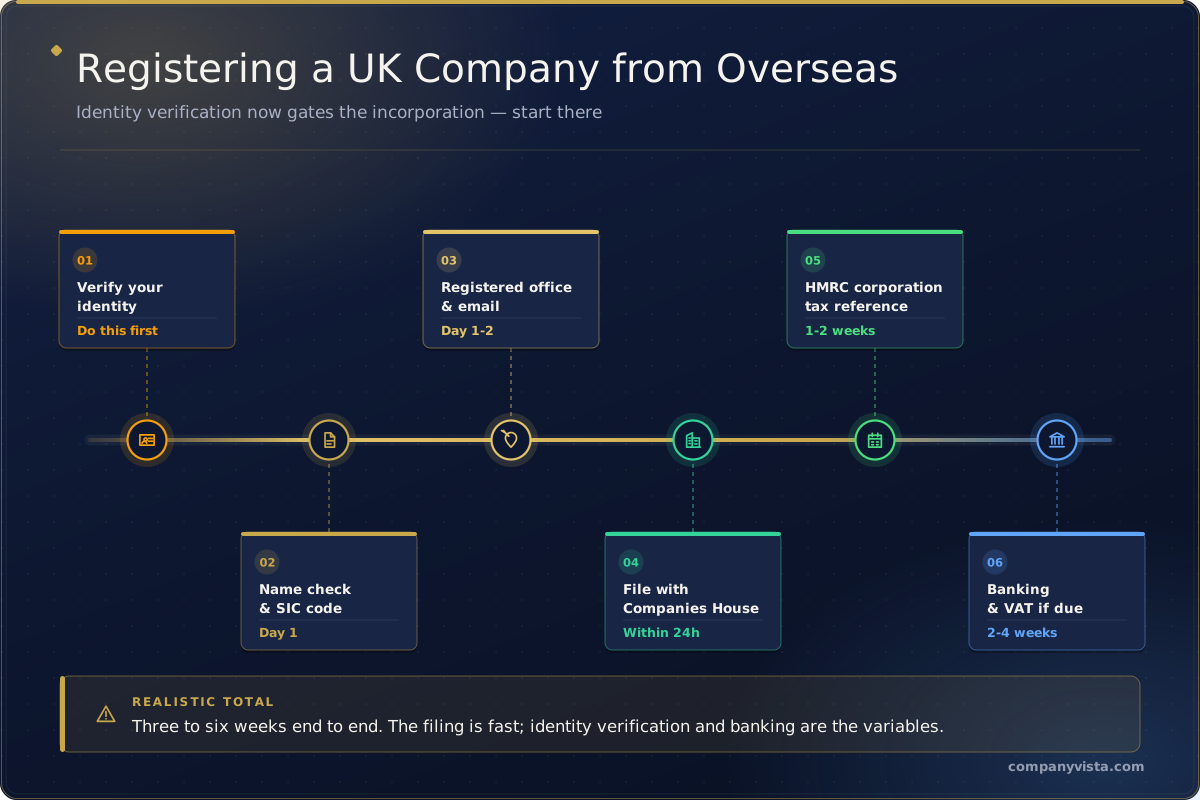
The order matters more than it used to. Identity verification now gates everything, so starting it first avoids a stalled filing.
- Verify your identity. Via GOV.UK One Login or an ACSP. Do this before anything else — the incorporation cannot be registered without it.
- Choose a company name. Checked against the Companies House index and against sensitive-word rules. Have a second preference ready.
- Choose your SIC code. The classification of what your business does. Pick one that genuinely matches your activity; banks read it.
- Arrange the registered office and registered email. A UK address meeting the "appropriate address" test. Your home address abroad cannot be used.
- Decide the share structure. Most founders issue a small number of GBP 1 ordinary shares. Keep it simple unless there is a reason not to.
- Identify your PSCs. Anyone holding more than 25% of shares or voting rights, or with the right to appoint or remove most of the board.
- File the incorporation with Companies House. Digital filing is usually processed within 24 hours; a same-day service is available.
- Register with HMRC for corporation tax. HMRC issues a Unique Taxpayer Reference, typically posted to the registered office within a couple of weeks.
- Open banking, and register for VAT if required — see the VAT section, because the threshold you have read about may not apply to you.
The PSC Register: What Becomes Public
The UK register is genuinely public and free to search, which surprises founders arriving from jurisdictions where ownership is private. It is worth knowing exactly what is visible before you file rather than after.
| Information | Publicly visible |
|---|---|
| Company name, number, registered office | Yes |
| Director name and nationality | Yes |
| Director month and year of birth | Yes |
| Director full date of birth | No — held, not published |
| Service (correspondence) address | Yes |
| Usual residential address | No, if a service address is given |
| PSC name and nature of control | Yes |
| Annual accounts | Yes |
| Registered email address | No |
A person with significant control is broadly anyone holding more than 25% of the shares or voting rights, or who can appoint or remove a majority of directors, or who otherwise exercises significant influence. If you own the company, you are a PSC, and your name will appear.
Use a service address rather than your home address. This is the single most effective privacy step available, it is entirely legitimate, and it is included with the registered office services most founders take anyway. What you cannot do is avoid appearing on the register at all — if anyone suggests otherwise, be very cautious about what they are actually proposing.
UK Business Banking for Non-Residents
This is the hardest part of the process, and it is worth being direct about that rather than discovering it after incorporation.
Traditional UK high-street banks generally expect a UK-resident director, a UK address and often an in-person meeting. For a founder living abroad, applications are frequently declined without a detailed explanation. That is a commercial policy decision by the bank, not a legal barrier, and no adviser can promise you an approval.
The practical route for most non-residents is a UK or EU electronic money institution offering business accounts with GBP details and a UK sort code, opened remotely. Expect to provide the certificate of incorporation, proof of identity and address, evidence of the business activity, and a clear explanation of expected transaction flows and counterparties.
For receiving payments internationally alongside a UK account, multi-currency receiving accounts are often opened in parallel rather than instead. Our multi-currency account comparison covers how these differ from a true business bank account.
Corporation Tax: 19%, 25% and Marginal Relief
A UK company is UK tax resident by virtue of incorporation, so corporation tax applies to its worldwide profits regardless of where you live.
- 19% small profits rate on profits up to GBP 50,000
- 25% main rate on profits above GBP 250,000
- Marginal relief tapers the effective rate between those two points
One detail that catches internationally-minded founders: those thresholds are divided by the number of associated companies. If you control two companies, the small profits threshold effectively halves to GBP 25,000 each. Founders who hold a UK company alongside a US LLC or a UAE entity frequently discover this at their first filing rather than when structuring.
Corporation tax is payable nine months and one day after the end of the accounting period, and the CT600 return is due twelve months after the period end. The payment deadline arrives before the filing deadline, which trips up first-year companies regularly.
VAT: Why You May Have No Threshold
If you take one thing from this guide beyond identity verification, take this.
The widely-quoted GBP 90,000 VAT registration threshold applies to businesses established in the UK. A business with no UK establishment — a non-established taxable person — has no threshold at all. If you make taxable supplies in the UK, registration is required from the first supply.
Whether your company is "established" in the UK is a question of substance, not of where it was incorporated. It turns on whether there is a fixed establishment with the human and technical resources to make or receive supplies. A company incorporated in London but run entirely by one founder living overseas, with no UK staff or premises, may well be non-established.
Getting this wrong means unregistered trading, VAT owed on past sales that you never charged your customers, plus interest and penalties. It is fact-specific and genuinely worth a professional opinion before you start selling rather than after.
Annual Compliance and Deadlines
The UK is inexpensive to maintain but unforgiving about dates. Companies House late filing penalties are automatic and escalate.
| Obligation | Filed with | When |
|---|---|---|
| Confirmation statement | Companies House | Annually — GBP 50 digital |
| Annual accounts | Companies House | 9 months after period end |
| Corporation tax payment | HMRC | 9 months + 1 day after period end |
| CT600 corporation tax return | HMRC | 12 months after period end |
| VAT returns (if registered) | HMRC | Usually quarterly, digitally |
| Identity verification of officers | Companies House | Ongoing — and by 18 Nov 2026 for existing officers |
| PSC register kept current | Company records | Within 14 days of any change |
Costs and Realistic Timeline
Two separate costs, and it is worth keeping them apart. Companies House fees go to the government. Service fees are what you pay a firm to prepare, file and support the company. The first alone does not get you an operating business.
Companies House fees increased on 1 February 2026, and a great deal of published content still quotes the old figures:
| Companies House fee | Current | Previously |
|---|---|---|
| Incorporation — digital | GBP 100 | GBP 50 |
| Incorporation — same day (digital) | GBP 156 | GBP 78 |
| Incorporation — paper | GBP 124 | GBP 71 |
| Confirmation statement — digital | GBP 50 | GBP 34 |
| Confirmation statement — paper | GBP 110 | GBP 62 |
| Voluntary strike off — digital | GBP 13 | GBP 33 |
To those, add the registered office and service address, identity verification support where you use an ACSP, and your annual accounts and corporation tax filings. CompanyVista provides a written quote before any payment is taken, so the full cost is visible in advance rather than revealed in stages.
On timing: the incorporation itself is genuinely fast — digital filings are commonly processed within 24 hours once identity verification is complete. Verification is the variable, and it is sensible to allow several days. The HMRC corporation tax reference arrives by post to the registered office, typically within a couple of weeks. Banking is the long pole. A realistic end-to-end expectation is three to six weeks to a company that is incorporated, tax-registered and able to receive payments.
Mistakes Non-Residents Make
- Leaving identity verification until filing. It gates the incorporation. Start it first, not last.
- Assuming the GBP 90,000 VAT threshold applies. Non-established businesses have no threshold. This is the costliest error on the list.
- Using a home address abroad, or a PO box, as the registered office. Neither meets the "appropriate address" requirement.
- Publishing a residential address unnecessarily. A service address is legitimate, inexpensive and permanent once filed. Correcting it later is harder than getting it right initially.
- Forgetting the associated companies rule. Holding other entities divides the corporation tax thresholds and can quietly move you from 19% to marginal rates.
- Missing the payment deadline while watching the filing deadline. Corporation tax is payable before the return is due, not after.
- Choosing a branch instead of a limited company. It exposes the parent and can force parent accounts onto a public UK register.
How CompanyVista Helps
CompanyVista is a document filing, taxation and accounting firm — not a law firm. Our team brings together US-credentialed CPAs, IRS Enrolled Agents, Certified Acceptance Agents, chartered accountants and filing specialists, with offices in Noida NCR and Albuquerque, New Mexico. Where a matter genuinely requires legal advice we work alongside independent attorneys in the relevant jurisdiction rather than offering it ourselves. We register companies in over 60 jurisdictions, including all four UK company types — see our full UK guides or compare against Canada if you are weighing common-law jurisdictions.
For UK company formation we handle the incorporation, the registered office and service address, guidance through identity verification, HMRC registration, and annual filings and accounts. Where a founder holds entities in more than one country — a UK company alongside a US LLC, for instance — we look at the combined position rather than filing each in isolation.
Every engagement starts with a free consultation and a written quote. We will also tell you when a UK company is not the right answer for what you are building, which happens more often than this industry admits.