What Form 5472 Is, and Why It Reaches You
Form 5472 is an information return. It reports no income and calculates no tax. Its entire purpose is to tell the IRS what money moved between your US company and you — the foreign person who owns it — or anyone else related to you.
That is worth sitting with for a moment, because it explains why so many founders are caught out. Nothing about Form 5472 behaves like a tax return. There is no threshold of profit below which it stops applying. There is no revenue figure that makes it unnecessary. It is a disclosure, and the obligation to disclose exists whether or not there is anything to tax.
Until 2017, a foreign-owned single-member LLC sat outside this regime entirely. It was disregarded for federal tax purposes, it had no US-source income in many cases, and it filed nothing. Treasury closed that gap. For tax years beginning on or after 1 January 2017, a foreign-owned US disregarded entity is treated as a domestic corporation solely for the purposes of section 6038A reporting.
The word "solely" matters. Your LLC does not become a corporation. It is not suddenly taxed at 21%. Nothing about its actual tax treatment changes. It is simply pulled into a reporting regime that was built for multinational groups, and handed the same penalty that was designed for them.
Who Must File Form 5472
Two categories of company must file Form 5472, and non-resident founders almost always land in the second.
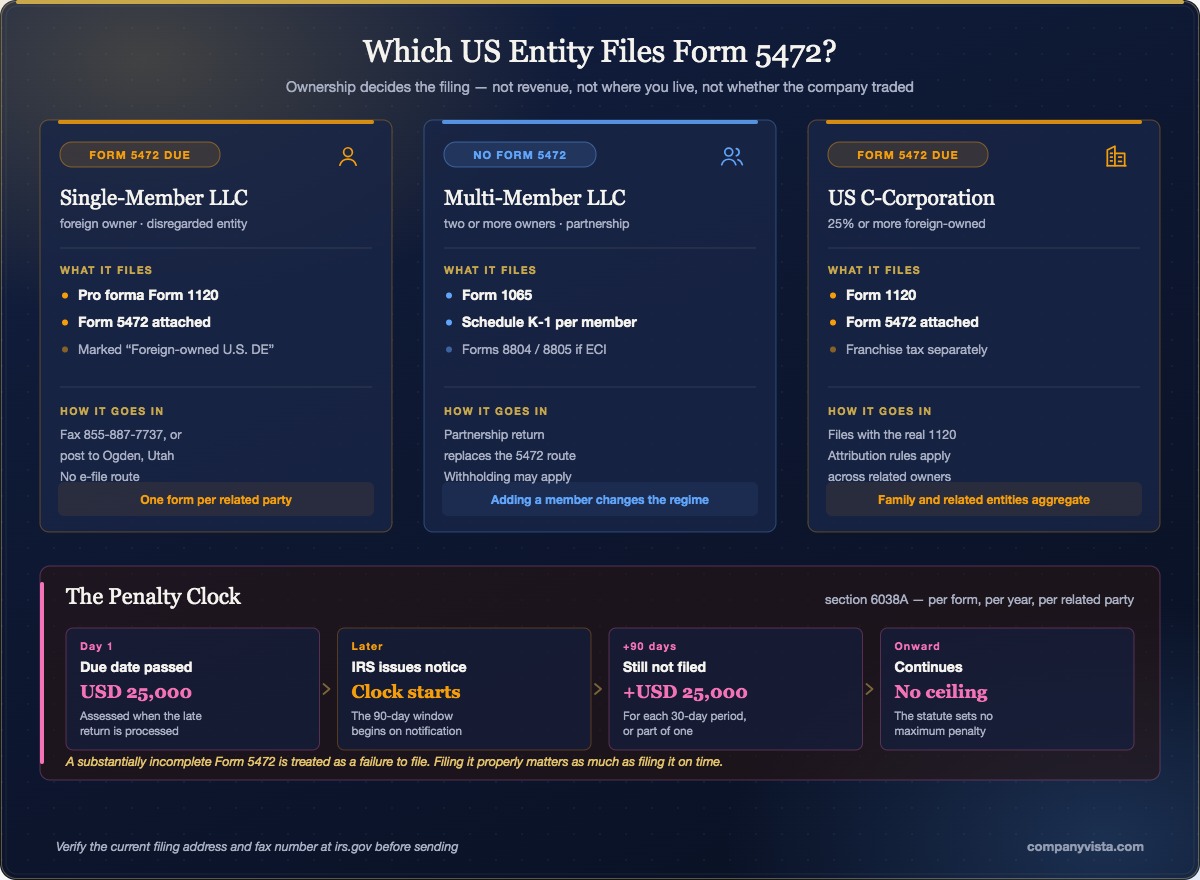
- A US corporation that is at least 25% foreign-owned. If you hold a quarter or more of a Delaware C-Corp from outside the United States, the company files Form 5472 alongside its real Form 1120.
- A foreign-owned US disregarded entity. In practice, a single-member LLC whose sole member is a non-US person or a non-US company. This is the Wyoming LLC, the New Mexico LLC, the Florida LLC that a founder abroad set up to take Stripe payments.
Ownership is what triggers Form 5472, not where you operate, not where your customers are and not whether you ever set foot in the United States. A founder in Bengaluru who has never visited America, whose LLC has one member and one bank account, is in scope.
One detail catches people whose ownership sits behind a holding company: the 25% test looks through to individuals and applies attribution rules, so ownership split across family members or related entities is aggregated rather than counted separately. Splitting an LLC between yourself and your spouse does not put you below the threshold.
Multi-Member LLCs Do Not File Form 5472
This distinction saves people a great deal of unnecessary work, and it is stated wrongly on a surprising number of websites.
The Form 5472 obligation for LLCs attaches to disregarded entities — companies with a single owner that the IRS does not treat as separate from that owner. Add a second member and the LLC is no longer disregarded. By default it becomes a partnership, and a partnership files Form 1065 with Schedules K-1 for each member instead.
So a two-member foreign-owned LLC does not file Form 5472 by reason of being foreign-owned. It has a different and generally heavier set of obligations: the partnership return itself, K-1s, and where the partnership has US-effectively-connected income, withholding on the foreign partners' share under sections 1446 and 1441 with Forms 8804 and 8805.
Why a Dormant LLC Still Files Form 5472
Here is the sentence that surprises almost every founder who reads it: an LLC that earned nothing, invoiced nobody and traded not at all still generally has to file Form 5472.
The reason is in the definition. For a foreign-owned disregarded entity, the regulations treat as reportable any amount paid or received in connection with the formation, dissolution, acquisition and disposition of the entity — expressly including contributions to it and distributions from it.
Read that against what actually happened in your first year:
- You transferred money in to open the bank account. A contribution.
- You paid the state filing fee from your personal card. A contribution.
- Your registered agent's fee came out of your own account. A contribution.
- You moved a few hundred dollars back out to yourself. A distribution.
Each one is a transaction between the company and its foreign owner. Each one is reportable. A company that has genuinely had no money move in either direction — not even a formation cost paid by the owner — is rare, and in our experience it is almost never the case that a founder believes to be true of their own company once they check the bank statement.
The practical rule we give clients: assume Form 5472 is due, and treat the rare exception as something to be established with evidence rather than assumed into existence.
What Counts as a Reportable Transaction
Part IV of the form lists the familiar categories — sales, rents, royalties, interest, commissions, amounts borrowed and lent. For an operating company these are the entries that matter. Part V is where the disregarded-entity additions go, and for most non-resident founders Part V is the only part with figures in it.
| Movement | Reportable on Form 5472? |
|---|---|
| You wire USD 5,000 in as working capital | Yes — contribution |
| You pay the Wyoming annual report fee personally | Yes — contribution |
| You draw USD 2,000 out to your personal account | Yes — distribution |
| The LLC pays you a consulting fee | Yes — amount paid to related party |
| You lend the LLC money, interest-free | Yes — amounts borrowed |
| The LLC buys software from an unrelated US vendor | No — unrelated party |
| A customer in Germany pays an invoice | No — unrelated party |
| Your other company abroad invoices this LLC | Yes — related party under common ownership |
Note the shape of that table. Transactions with customers and suppliers are generally not reportable. Transactions between the company and you, or anything else you control, are. Founders who run several entities across jurisdictions — a UK company, a UAE free zone entity, an Indian private limited — frequently have related-party flows they had not thought of as such.
The Pro Forma Form 1120 That Carries It
Form 5472 is never filed on its own. It is an attachment, and it attaches to a return.
A foreign-owned C-Corp attaches it to the Form 1120 it was going to file anyway. A foreign-owned single-member LLC has no Form 1120 to file, because it is a disregarded entity — so the IRS requires a pro forma one: a Form 1120 completed only as far as the identifying details at the top, with "Foreign-owned U.S. DE" written across the top of page one, and Form 5472 stapled behind it.
The income and deduction lines stay empty. You are not reporting profit on it. The pro forma 1120 is a carrier, nothing more, and the substance of the filing is the Form 5472 behind it.
Two things are needed before any of this can happen. The LLC must have an EIN — if you do not yet have one, our guide to getting an EIN without an SSN covers the routes open to non-residents. And you need the reference numbers for the foreign owner, which for an individual with no US tax identification number means entering the details the form asks for and marking the absence rather than leaving the box blank.
How to File Form 5472: Fax or Post Only
The Form 5472 instructions are unambiguous: a foreign-owned US disregarded entity cannot file Form 5472 electronically.
This surprises people more than anything else in the process. There is no e-file route. Consumer tax software will not submit it. A filing that exists to satisfy a modern information-reporting regime is delivered by fax machine or by international post.
| Route | Detail |
|---|---|
| Fax | 855-887-7737. Send at 300 DPI or higher. Keep the transmission confirmation — it is your proof of filing, and it is the document you will want if the return is ever said not to have arrived. |
| Post | Internal Revenue Service, 1973 Rulon White Blvd, M/S 6112, Attn: PIN Unit, Ogden, UT 84201. Use a trackable service from outside the United States. |
| Electronic | Not available to a foreign-owned US DE. |
| What goes in the envelope | Pro forma Form 1120 marked "Foreign-owned U.S. DE", with Form 5472 attached behind it. One Form 5472 per related party. |
That last line is easy to miss. The form is filed per related party. An LLC with transactions with its foreign owner and with a second company that owner controls files two, and the penalty applies to each one separately.
Deadlines, and the Extension That Buys Six Months
Form 5472 follows the due date of the return it is attached to. For a calendar-year foreign-owned single-member LLC, that is 15 April of the following year.
An extension to 15 October is available by filing Form 7004, and this is where a specific trap sits: the extension must be sent by the original due date, to the same fax number or Ogden address. Filing Form 7004 through software, or to the address a US-domestic corporation would use, does not reliably extend a filing that itself cannot be e-filed.
The first filing is the one most often missed entirely. A company formed in, say, August 2025 has a first tax year ending 31 December 2025 — a partial year of four months, during which the only thing that happened was formation and funding. Form 5472 for that stub year was due on 15 April 2026. Founders who formed in the autumn and have not yet traded routinely assume their first filing is more than a year away. It is not.
The USD 25,000 Penalty, and the One That Follows It
The penalty for failing to file Form 5472 is USD 25,000. Not a percentage of anything. Not scaled to the size of the company or the amounts reported. A flat USD 25,000, per form, per year.
The Form 5472 penalty is assessed against the reporting corporation — which, for a foreign-owned LLC, is the company itself rather than you personally. That is cold comfort in practice, because the company is yours and the liability sits on it either way, but it matters if the entity is ever sold or transferred.
It does not stop there. If the failure continues for more than 90 days after the IRS notifies you, a further USD 25,000 applies for each 30-day period, or part of a period, during which it continues — and the statute sets no maximum. A company that receives a notice and does nothing for six months is looking at a figure that has multiplied several times over.
| Situation | Exposure | Note |
|---|---|---|
| One missed year, one related party | USD 25,000 | Assessed when the late return is processed |
| Three missed years, one related party | USD 75,000 | The penalty is per form, per year |
| One missed year, two related parties | USD 50,000 | Two forms were due, two were missed |
| Notice issued, no response for 6 months | USD 25,000 plus USD 25,000 per 30-day period after day 90 | No statutory ceiling |
| Filed, but substantially incomplete | Treated as a failure to file | An empty form filed on time is not automatically safe |
That last row deserves attention. A Form 5472 submitted with the transaction sections left blank because "nothing really happened" can be treated as substantially incomplete, which puts the filer in the same position as one who never filed at all — with the added difficulty of having made a positive statement that was wrong. Completing it properly matters as much as completing it on time.
If You Have Already Missed Years
A significant share of the people who find this article are not planning a filing. They are discovering an obligation that has been running for two or three years.
The position is better than it looks, but only if you move first. What matters is that the filings go in before the IRS raises the matter, and that each late Form 5472 carries a reasonable-cause statement explaining why it was late in terms of ordinary business care and prudence.
- File every missed year, not just the most recent. A partial catch-up leaves the earlier years open indefinitely, because the limitation period on an unfiled information return does not begin to run.
- Attach a reasonable-cause statement to each one. Specific facts carry weight; general regret does not. Who advised you, what you were told, when you discovered the position and what you did immediately afterwards.
- Expect the penalty to be assessed anyway. These penalties are applied systemically on processing, frequently before the attached statement is read by anyone. That is not a reason to leave the statement out — it is the document your abatement request will rest on.
- First-time abatement may be available. Where the penalty was systemically assessed and the prior three years are clean, administrative first-time abatement has been applied to Form 5472 penalties. It is discretionary, and it is not available to a company with a pattern of late filing behind it.
- Appeals remain open. A refused abatement is not the end of the matter.
What does not work is waiting. Every month that passes adds another year's penalty exposure and weakens the reasonable-cause argument, because the strongest version of that argument is that you corrected the position the moment you understood it.
The Records You Are Required to Keep
Section 6001 requires permanent books and records sufficient to establish the accuracy of the return, and for a reporting corporation that expressly extends to records relevant to the treatment of related-party transactions.
In plain terms, the Form 5472 you file has to be supportable: you should be able to show, from your own records, how each reportable figure on it was arrived at. That means keeping, for each year:
- Bank statements for every account the company holds, for the full year
- A record of every transfer between you and the company, in both directions, with the date, amount and currency
- The exchange rate applied to any transaction not in US dollars, and the source of it
- Invoices between the company and any entity you control elsewhere
- Formation documents, the EIN confirmation letter and your registered agent's records
Records held only in a bank's online portal are not a record. Portals close accounts, drop history beyond a retention window and become unreachable if the relationship ends. Download statements annually as PDFs and keep them somewhere you control — a discipline that costs an hour a year and repeatedly saves clients from reconstructing a closed USD business account from memory.
Mistakes Non-Residents Make With Form 5472
| Mistake | What it costs |
|---|---|
| Assuming no revenue means no filing | The most common failure by a wide margin. Formation and funding are reportable, so Form 5472 is due for the first year of a company that never traded. |
| Trying to e-file it | There is no e-file route for a foreign-owned DE. Software that appears to accept it is not filing this return, and the deadline passes while the founder believes it is done. |
| Filing the pro forma 1120 without the annotation | "Foreign-owned U.S. DE" across the top of page one is what routes it correctly. Without it the return can be processed as something else entirely. |
| Sending Form 7004 to the wrong place | An extension that was not received by the original due date is no extension, and the late-filing penalty runs from 15 April regardless. |
| Filing one form where two were due | One Form 5472 per related party. A second controlled entity means a second form, and a second USD 25,000 if it is missed. |
| Leaving the transaction sections blank | A substantially incomplete form is treated as a failure to file, with a wrong positive statement on the record as well. |
| Dissolving the LLC to make it go away | Dissolution is itself a reportable event, and closing the company does not extinguish filings that were already due. Close it properly or the exposure follows you. |
| Waiting for the IRS to make contact | Voluntary late filing with a reasonable-cause statement is a materially better position than a response to a notice, and the continuation penalty only begins once a notice has been issued. |
How CompanyVista Helps
We prepare and file Form 5472 with the pro forma Form 1120 for foreign-owned single-member LLCs, by the route the IRS requires, and we keep the transmission confirmation on file. Where a company is behind, we establish how many years are open, quantify the exposure honestly before any work begins, and prepare the catch-up filings with reasonable-cause statements.
Our team includes US-credentialed CPAs and IRS Enrolled Agents, which matters here specifically: an Enrolled Agent can represent you before the IRS on a penalty abatement, which is frequently the part of this that decides the outcome. We are a document filing, taxation and accounting firm and do not provide legal advice; where a matter requires it, we work alongside independent attorneys in the relevant jurisdiction.
A written quote is provided before any payment, normally within 4 to 24 hours of your enquiry. Ongoing compliance and accounting support covers the annual Form 5472 alongside your state annual report and registered agent renewal, so the deadline is diarised rather than remembered.