Why Non-Residents Need a USD Account
For most founders outside the United States, the US company was never the goal. A USD business bank account was.
A USD business account with a real account number and routing number is what unlocks the rest: Stripe, PayPal, Amazon Seller Central, and US clients who would rather pay a domestic supplier than send an international wire. A USD business account removes the currency conversion that quietly erodes margin on every invoice, and it gives you a banking relationship your customers recognise. You will need an EIN before any of it, which non-residents can obtain without an SSN.
The good news is that a USD business account is genuinely achievable from anywhere, remotely, usually within a week or two of having your EIN. The part that gets less attention — and the reason this guide is longer than most — is that opening the account is not the hard part. Keeping it open is. A meaningful share of the founders who come to us have already had one account closed, and almost always for a reason that was avoidable at the application stage.
What a USD Business Account Actually Is
A point of clarity before the platforms, because it removes most of the confusion around USD business bank accounts for non-residents.
Everything in this guide is a USD business account held by a company. All three platforms require a registered company — none of them opens a business account for an individual, and the personal receiving accounts some of them also offer are a different product that is not covered here.
Traditional US banks — Chase, Bank of America, Wells Fargo — generally require an in-person visit and often a US-resident signatory. They are not realistically open to a founder applying from Dubai or Bengaluru. That is a commercial policy rather than a legal barrier, but the outcome is the same.
The three platforms below all onboard remotely and all give you a genuine business account: local account details, cards, incoming and outgoing transfers, and the ability to pay suppliers and be paid by clients and marketplaces. The differences between them are not really about capability. They are about which entity they accept, what identification they require, and — the part founders discover too late — whether there is a human being involved when something goes wrong.
Payoneer
Payoneer is the platform we recommend most often to non-resident founders, and the reasons have less to do with features than with what happens when an application is not straightforward.
On capability it is a full business account, and in one respect a broader one than either alternative. You get local receiving details in multiple currencies — USD, EUR, GBP, CAD, AUD, JPY and others — rather than a single USD account. Your American client pays you by domestic ACH transfer, your German client by SEPA, your British client by Faster Payments. None of them sends an international wire, and none of them pays a wire fee to work with you.
That is a commercial advantage as much as a banking one. Being easy to pay wins business. Mercury and Lili give you a USD account; every non-US client of yours is then making an international transfer.
Beyond the accounts you get cards, outgoing transfers, supplier and contractor payments, and direct integration with over 2,000 platforms including Amazon, Upwork, Fiverr, Airbnb and Shopify. Funds move to your local bank account in your home country cleanly — our multi-currency account comparison covers that in detail. Like the others, it requires a registered business; this is a business account, not a personal one.
The material gap against a US bank account is check deposit. Payoneer does not accept paper cheques. For a business paid by card, transfer or marketplace — which is almost every business reading this — that is not a limitation you will notice. If your US clients still pay by physical cheque, it is.
One further honest note: Payoneer’s currency conversion is competitive against a bank but not the cheapest available — a dedicated FX provider will usually beat it on rate. If you convert very large volumes between currencies, it is worth pricing that leg separately rather than assuming one platform should do everything.
Applications go through a named account manager rather than an algorithm. Where something needs explaining, it gets explained — and you are asked for the additional document rather than declined without one.
Businesses registered in over 150 countries are eligible. Mercury and Lili accept US companies only. If you expand into a second jurisdiction later, your banking travels with you rather than starting again.
That second point deserves expanding, because it is the single biggest practical difference between these platforms.
Mercury and Lili are self-service. You submit, an automated review runs, and you are approved or you are not. Where an application is declined, neither platform generally explains why, and neither invites you to supply more information. You are left guessing which part of your application caused it — and a second application after a decline is materially harder than the first.
Through CompanyVista's partnership, Payoneer applications are handled with assisted onboarding and a dedicated account manager. Our team works alongside Payoneer on the file. If a question arises about your business model, your counterparties or your documentation, it is raised with us and put to you, with a chance to answer it properly. Applications are not declined cold.
For a founder whose situation is anything other than textbook — an unusual business model, a newer company, a country that attracts extra scrutiny, no passport — that difference decides the outcome.
The stability question nobody asks until it matters
Earlier in this guide we noted that none of these platforms is a chartered bank. Payoneer is the partial exception, and it is worth understanding why.
Payoneer has been operating since 2005 and is a publicly listed company on NASDAQ under the ticker PAYO. It holds regulatory authorisations in its own right across multiple jurisdictions — money transmitter licences across US states, FCA authorisation in the United Kingdom, an e-money institution in Europe, and regulated status in Singapore, Hong Kong, Japan, Australia and Canada.
Contrast that with the structure of the alternatives. Mercury and Lili are privately held US startups, founded in 2017 and 2019 respectively, that rely on partner banks for the underlying banking permissions. There is nothing improper about that model — it is how most US fintechs are built — but it means your account depends on a commercial relationship between two private companies, and you cannot inspect the financial health of either.
A listed company files quarterly and annual accounts with the SEC. If you want to know whether the business holding your money is solvent, you can read it. For a founder who has watched a fintech freeze balances or exit a market, that is not an abstract distinction.
Mercury
Mercury is a strong option for founders with a US entity and a straightforward profile. You get a US business checking account with account and routing numbers, virtual and physical cards, international wires, and cheque deposit.
It suits US-facing businesses with real transaction volume — SaaS companies, agencies invoicing US clients, e-commerce sellers running Stripe or Amazon — where the founder holds a passport and lives in a country that is not on the restricted list.
Lili
Lili onboards non-residents remotely with no Social Security Number required, with banking services provided by Sunrise Banks, N.A. What distinguishes it is the built-in bookkeeping, expense categorisation and tax set-aside tools, which replace software a freelancer would otherwise buy separately.
It suits solo consultants, freelancers and single-owner e-commerce businesses with a US entity and simple accounting. Like Mercury, it requires a passport and a US company, and onboarding is self-service.
One practical detail: you will need a US mailing address for physical card delivery. A registered agent or virtual address service covers this, and it is worth arranging before you apply rather than mid-application.
Which USD Business Account Fits You
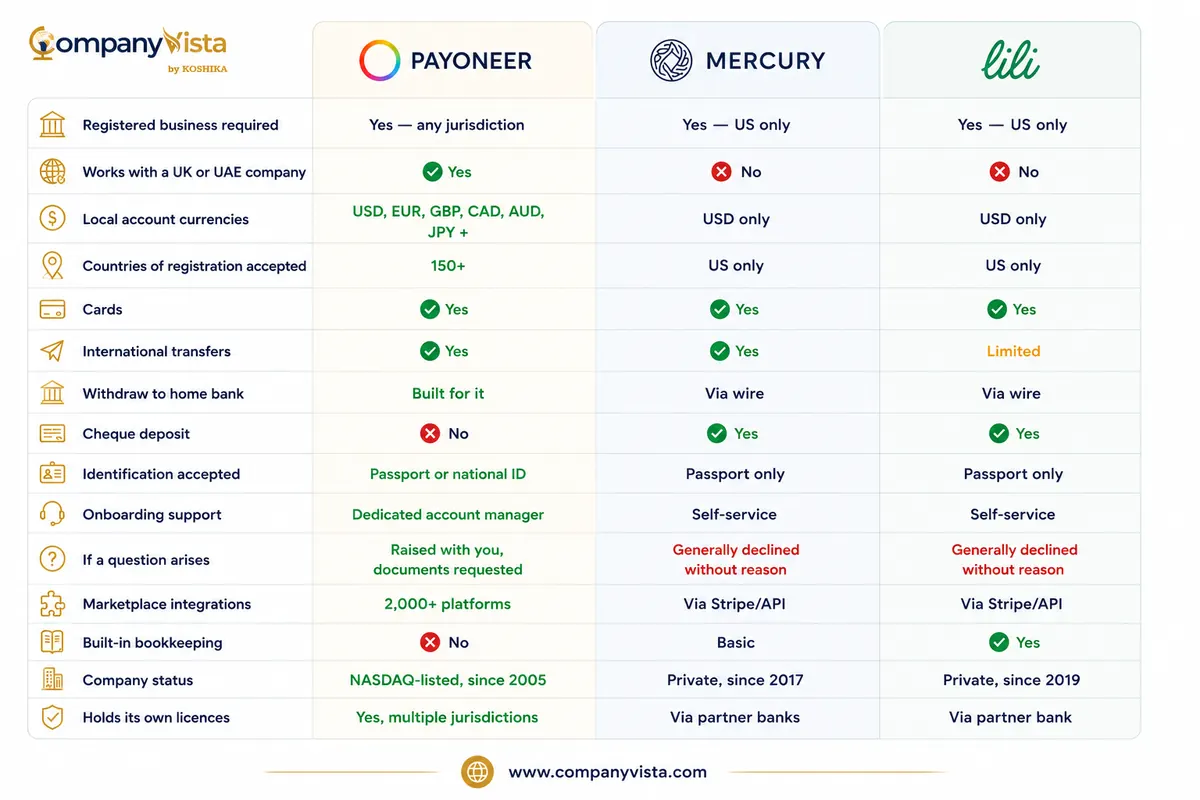
On core banking capability there is less between these USD business accounts than most comparisons suggest. The decisive factors are your entity, your identification, and how much support you want behind the application.
| Payoneer | Mercury | Lili | |
|---|---|---|---|
| Registered business required | Yes — any jurisdiction | Yes — US only | Yes — US only |
| Works with a UK or UAE company | Yes | No | No |
| Local account currencies | USD, EUR, GBP, CAD, AUD, JPY + | USD only | USD only |
| Countries of registration accepted | 150+ | US only | US only |
| Cards | Yes | Yes | Yes |
| International transfers | Yes | Yes | Limited |
| Withdraw to home bank | Built for it | Via wire | Via wire |
| Cheque deposit | No | Yes | Yes |
| Identification accepted | Passport or national ID | Passport only | Passport only |
| Onboarding support | Dedicated account manager | Self-service | Self-service |
| If a question arises | Raised with you, documents requested | Generally declined without reason | Generally declined without reason |
| Marketplace integrations | 2,000+ platforms | Via Stripe/API | Via Stripe/API |
| Built-in bookkeeping | No | Basic | Yes |
| Company status | NASDAQ-listed, since 2005 | Private, since 2017 | Private, since 2019 |
| Holds its own licences | Yes, multiple jurisdictions | Via partner banks | Via partner bank |
Choose Payoneer if your company is registered outside the US, if you do not hold a passport, if you are paid in more than one currency, if you want clients paying you locally rather than by international wire, if you may expand into another jurisdiction, or if your business model is anything other than textbook and you would rather have someone advocating for the file than an automated decision.
Choose Mercury if you have a US entity, a passport, a straightforward profile and US clients who pay by cheque.
Choose Lili if you are a solo founder with a US entity and want bookkeeping inside the banking app.
Many founders run two: Payoneer for multi-currency income and repatriation, plus a US account for domestic operations. We compare all three head to head in Mercury vs Payoneer vs Lili.
Documents and the Application
All three USD business account applications ask for broadly the same things. Assemble them before you start, because a half-completed application left open for days is itself a small negative signal.
What You Will Need:
- EIN letter — IRS CP 575 or 147C
- Formation documents — Articles of Organization / Incorporation
- Governing document — Operating Agreement or bylaws
- Identification — Passport, clear scan
- Home address proof — Utility bill or bank statement
- US address — Registered agent or virtual address
- Business description — Plain, specific, honest
- Expected activity — Volumes, countries, counterparties
The last two carry more weight than founders expect. The reviewer is trying to answer one question: does this account make sense? A description that matches the SIC code on your formation, the website you operate and the payments that later arrive is worth more than any amount of documentation.
Timing for a USD business account is usually a few business days to a couple of weeks. Approval is never guaranteed, at any platform, and no adviser can promise otherwise.
Where You Live Matters
Residence is the hard filter on any USD business account application, and it is applied before anything else is considered.
Mercury publishes a prohibited-countries list covering dozens of countries and several sanctioned regions. Two features of it surprise people. First, it is scoped to where a founder or controller lives, not to citizenship — so a Nigerian passport holder resident in Dubai is assessed differently from the same person resident in Lagos. Second, it is not confined to the countries you would guess: several European countries appear on it, including EU member states.
Relay and other platforms maintain their own lists with different scoping — some apply the restriction to citizenship as well as residence, which catches dual nationals.
A separate and often-missed restriction: physical card delivery is paused to several countries independently of account eligibility, including parts of the Gulf. You may be approved for an account and still be unable to receive a physical card. Virtual cards generally remain available, which is sufficient for most online businesses.
Why USD Business Account Applications Are Declined or Closed
Two different questions, and the second is the one that costs people more.
At application
- Residence on a prohibited list. The hard filter above.
- A vague business description. "Consulting" or "general trading" tells a reviewer nothing and reads as evasive.
- Inconsistency. The formation documents say one thing, the website says another, the application says a third.
- Incomplete documentation, particularly a missing or mismatched EIN letter.
After opening — the expensive ones
Accounts that open cleanly are increasingly receiving a follow-up compliance review a few weeks in, once real money starts moving. Three patterns close non-resident accounts more than any others:
- Dormancy. Founders who open an account "to have it ready" and leave it unused for months attract questions when activity finally arrives. An account with no history and a sudden inflow looks materially different from one used steadily from week one.
- Third-party payments. Receiving or sending money on behalf of someone else — a friend's business, a client's client — is treated as a serious breach, not a technicality.
- Crypto trading. Regardless of legality in your own country, this is outside most platforms' acceptable use.
"Open the account when you are ready to use it, not months in advance. A dormant account with a sudden first inflow is one of the most reliable ways to trigger a compliance review you did not need."
If a platform contacts you for more information, reply within the stated deadline. Silence escalates a restriction into a closure, and closures are rarely reversed.
This is where the onboarding route matters. On a self-service application there is usually no conversation — a decline arrives without a reason and you are left reapplying blind. Where an application is handled with a dedicated account manager, the question is put to you first and answered with a document, which is a materially different outcome from the same underlying concern.
Stripe, PayPal and Amazon After Approval
For most founders, the account was always a means to this end.
With a registered company and a business account in place, you can apply to Stripe directly — no separate incorporation product is needed. PayPal Business and Amazon Seller Central follow the same pattern. Our guide to Stripe and PayPal for non-resident LLC owners covers the application detail.
Two honest qualifications. A US entity and account improve your position with payment processors; they do not guarantee acceptance, and high-risk categories remain difficult wherever you are incorporated. And keep the business description consistent across your entity, your bank and your processor — a mismatch between what Stripe believes you sell and what your bank believes you sell will eventually surface at one of them.
What a Foreign Account Means Back Home
A US business account is a foreign financial account from the perspective of your country of residence, and that usually carries a disclosure obligation regardless of the balance.
For Indian residents, this means the account and your interest in the US entity are disclosable in Schedule FA of your income tax return, with the Black Money Act applying to non-disclosure. Founders frequently assume disclosure begins when money is repatriated. It does not — the holding itself is disclosable. Our India-to-US guide covers this together with the FEMA reporting that applies to the underlying investment.
Other jurisdictions have their own equivalents, and most now receive account information automatically under international exchange frameworks. The practical point is the same everywhere: the account is visible to your home tax authority, so the disclosure is not optional and is far cheaper to do correctly from the start.
Mistakes That Cost People Their USD Business Account
- Applying before the EIN exists. Every USD business account application asks for the IRS letter. Sequence it properly.
- Opening early "to be ready". Dormancy is a genuine closure risk, not a neutral state.
- Describing the business aspirationally. Describe what you do now, in plain language, not what you intend to do next year.
- Applying to all three at once. Multiple simultaneous applications, and repeat applications after a decline, are visible and unhelpful. Pick the platform that fits your entity and identification first.
- Applying self-service when your file needs explaining. A newer company, an unusual model or a country under extra scrutiny is exactly when an assisted application is worth more than a fast one.
- Running a friend's payments through the account. The fastest route to closure on this list.
- Ignoring a compliance email. A request for information has a deadline. Silence turns a question into a closure.
- Assuming a US account works with a non-US company. It generally does not. Match the account to the entity.
- Skipping the disclosure at home. The account is visible to your tax authority whether or not you declare it.
How CompanyVista Helps
CompanyVista is a document filing, taxation and accounting firm — not a law firm — led by Rakesh Kumar, a US-credentialed CPA, IRS Enrolled Agent and Certified Acceptance Agent, with offices in Noida NCR and Albuquerque, New Mexico.
We coordinate USD business account applications for non-resident founders as part of company formation, or as a standalone engagement where the entity already exists. That means matching the platform to your entity and residence before you apply, preparing the documentation set, and framing the business description accurately — the three things that decide most applications.
For Payoneer specifically, our partnership means assisted onboarding and a named account manager — your file is discussed rather than scored. We will also tell you when your country of residence or entity makes a particular platform a poor use of an application. Every engagement begins with a free consultation and a written quote before any payment.