What e-Residency Actually Is, and Is Not
Estonia company formation is usually reached through e-Residency, so it is worth being precise about what that is. Estonia e-Residency is a government-issued digital identity. It gives you a card and reader that let you sign documents with legal force, access Estonian e-services, and form and run an Estonian company entirely online from anywhere.
That is all the programme is, and it is genuinely useful. The confusion comes from the word "residency".
Not citizenship, and no path towards it.
Not a visa. It has no immigration effect whatsoever.
Not tax residency. You remain tax resident where you actually live, and that country continues to tax you under its own rules.
Not a bank account. This is the one that catches people hardest — see the banking section below.
What the digital ID does give you is the ability to run an EU company from a laptop in Lagos, Bengaluru or Buenos Aires without ever visiting Europe. For the right business, that is worth a great deal.
The 0% That Is Not 0%
This is the single most misunderstood thing about Estonia, and it is misunderstood because the marketing is technically accurate.
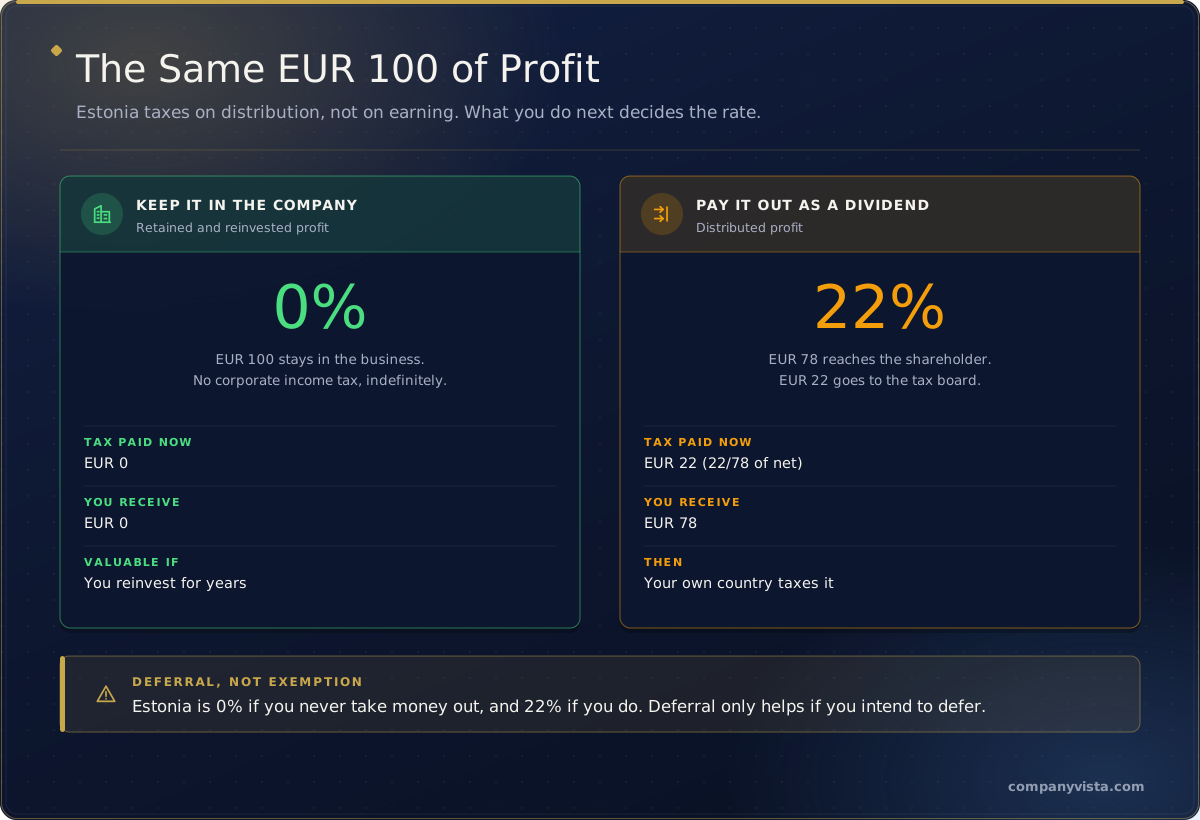
Estonia does not tax retained profits. Money retained inside the company and reinvested is taxed at 0%, indefinitely. That is genuinely unusual — most countries tax annual profit whether you take it out or not — and for a business reinvesting everything it is a real advantage.
But the moment you distribute profit, corporate income tax applies at 22/78 of the net amount. The 22/78 formula is the whole of Estonian corporate tax. A company with EUR 100 available for distribution can pay out EUR 78 and owes EUR 22 in tax. That is an effective 22% of the gross.
So the question that decides whether Estonia suits you is simple: do you plan to take a distribution every year, or leave profit retained for several years?
If you are building something capital-hungry and reinvesting everything, Estonia's model is excellent and the deferral compounds. If you are a consultant who draws profit every year, you are looking at roughly 22% at the company level plus whatever your own country charges you — and Estonia's headline advantage has evaporated.
Why Founders Choose Estonia Company Formation
Strip away the tax myth and Estonia company formation has a genuinely strong proposition underneath.
It is the most digital jurisdiction in Europe. Formation, filings, tax returns and signatures are all online. There is no notary appointment, no apostille, no courier of paper documents — which is a meaningful contrast with Germany, where notarisation is mandatory and legalising foreign documents sets the timeline.
It is an EU company. You get an EU VAT number, EU market access, and a corporate form European customers and platforms recognise.
Capital is not a barrier. Estonia company formation no longer carries the former EUR 2,500 minimum share capital, removed in 2023. A company can now be registered with as little as one cent per shareholder.
The deferral is real. For a business reinvesting profit, retained earnings accumulate with no corporate tax for several years, and that retained capital funds growth that would otherwise be taxed away. It is a genuine structural advantage, not a marketing line.
A record number of companies were registered by e-residents in 2025, and the volume tells you the process works at scale. It does not tell you the structure suits every business — which is what the rest of this guide is about.
The OÜ: What You Are Actually Forming
The standard vehicle for Estonia company formation is the osaühing, or OÜ — a private limited company, broadly equivalent to a UK Ltd or a German GmbH.
| Feature | Position |
|---|---|
| Minimum share capital | Effectively none — from EUR 0.01 per shareholder since 2023 |
| Shareholders | One or more, any nationality, resident anywhere |
| Management board | At least one member, no residency requirement |
| Contact person in Estonia | Required if no board member resides in Estonia |
| Legal address in Estonia | Required |
| State registration fee | EUR 265 for online registration |
| Formation method | Fully online with e-Residency; notary route available without it |
| Liability | Limited to the company's assets |
Worth knowing: you do not strictly need Estonia e-Residency to own an Estonia company. A notary route exists for founders who cannot or prefer not to obtain the digital ID. The digital ID simply makes everything — formation, signing, filing, banking applications — considerably easier to do remotely.
Contact Person and Legal Address
These two requirements are legal obligations rather than optional services, and they are the recurring cost most formation quotes understate.
If no member of your management board resides in Estonia — which is the case for virtually every e-resident founder — you must appoint an Estonian contact person authorised to receive official correspondence on the company's behalf, and maintain a legal address in Estonia. Both must be provided by licensed service providers.
Expect each to cost a few hundred euros a year. They are not large sums, but they recur for the life of the company whether or not it trades, and a quote that mentions only the EUR 265 state fee is not showing you the real annual cost.
Estonia Company Formation: How the Process Works
| Step | What happens | Timing |
|---|---|---|
| 1. Digital ID application | Online application with passport copy, photo, motivation statement and a state fee. Background checks are performed by the Estonian Police and Border Guard. | 3–8 weeks |
| 2. Collect the card | In person at a chosen Estonian embassy or pickup point. This is the one step that cannot be done remotely. | Appointment-dependent |
| 3. Contact person & legal address | Appointed through a licensed provider, before registration. | Days |
| 4. Company name and articles | Name checked against the Business Register. Standard articles are available for straightforward companies. | Day 1 |
| 5. Register the OÜ | Filed online through the Business Register portal with the EUR 265 state fee. | Often within 1 working day |
| 6. Business account | Estonian bank or EU fintech. The slowest and least predictable step. | 2–10 weeks |
| 7. VAT registration | Where required by turnover or EU trading. | Days to weeks |
Note step 2. Estonia e-Residency is marketed as fully remote, and the company formation genuinely is — but the card itself must be collected in person at an Estonian embassy or designated pickup point. For founders in countries without a convenient location, that single requirement is worth checking before you plan around it.
Banking: The Real Weakness of an Estonia Company
If an Estonia company has a structural problem for non-EU founders, this is it, and it deserves to be stated plainly rather than buried.
The digital ID does not come with a bank account, and Estonian banks are not obliged to open one. Traditional Estonian banks apply substantial scrutiny to companies whose directors, operations, customers and revenue are all outside Estonia. They look for a genuine connection to Estonia or the EU, and where they do not find one, applications are frequently declined without a detailed explanation.
This is not a rule you can argue with. It is a commercial and compliance policy, applied consistently, and no adviser can promise you an approval.
The practical route for most founders here is an EU electronic money institution offering business accounts with an IBAN, opened remotely. This is legitimate and extremely common — a large share of e-resident companies operate this way. Our guides to business accounts for non-residents and multi-currency accounts cover the options, and we coordinate applications as part of the formation rather than leaving you to it.
VAT at 24% and When It Applies
Estonia's standard VAT rate is 24%, following a permanent increase in July 2025. Registration becomes mandatory once taxable turnover in Estonia passes the threshold, and an Estonian VAT number is generally needed to trade within the EU.
The common error is assuming that because your customers are outside Estonia, VAT never applies. Whether you charge it depends on place-of-supply rules — who your customer is, whether they are a business or a consumer, and where they are established. Digital services to EU consumers in particular have their own regime, and getting it wrong accumulates a liability quietly.
This is a question for an accountant at the point you start invoicing, not an assumption to carry forward.
What Your Own Country Does About It
An Estonia company does not change where you are tax resident, and this section matters more than the Estonian rate for most readers.
You remain taxable where you live, on the basis your own country applies. Three things commonly bite:
- Controlled foreign company rules. Many countries attribute the undistributed profits of a foreign company back to its owner where the foreign entity is lightly taxed and lacks substance. Estonia's deferral is exactly the pattern those rules were written for. If your country has CFC rules, the deferral may not survive them.
- Place of effective management. A company run entirely from your kitchen table may be treated as tax resident in your country rather than Estonia, regardless of where it is registered.
- Disclosure. Your shareholding and any foreign account are almost certainly reportable at home. For Indian residents that means Schedule FA, with the Black Money Act applying to non-disclosure — see our India guide for how that works alongside FEMA reporting.
None of this makes Estonia a bad choice. It makes it a choice that has to be assessed against your own country's rules rather than on Estonia's headline rate alone.
Annual Compliance and Reporting
| Obligation | Detail | Frequency |
|---|---|---|
| Annual report | Filed with the Business Register. Mandatory even for a dormant company. | Annual |
| Corporate income tax return | Filed monthly where there are taxable distributions or payments; nil returns otherwise. | Monthly |
| VAT returns | Where registered. | Monthly |
| Bookkeeping | Required throughout. The annual report cannot be produced without it. | Ongoing |
| Contact person & legal address | Maintained continuously while no board member resides in Estonia. | Annual |
| Beneficial owner data | Kept current in the Business Register. | On change |
An Estonia company is inexpensive to maintain but not maintenance-free, and the annual report obligation applies whether or not the company traded. Accounting support is not optional in practice — the filings are in Estonian and the corporate tax return runs monthly.
Estonia Company Formation Cost and Timeline
Estonia company formation cost falls into three groups. State fees: the digital ID application fee, set by the programme, and the EUR 265 company registration fee. Mandatory recurring services: contact person and legal address, typically a few hundred euros each per year. Accounting, which is effectively unavoidable given monthly filings in Estonian.
Estonia sits outside the small group of jurisdictions where we publish fixed pricing, so we do not quote a headline figure here. We provide a written quote covering all three groups before any payment is taken, so the real annual cost is visible before you commit rather than at the first renewal.
On timing: the digital ID application takes several weeks and requires an in-person card collection. Company registration itself is often complete within a working day once you hold the card. Banking is the variable. A realistic end-to-end expectation is two to four months, dominated by the digital ID wait and the banking application.
Mistakes Founders Make
| The mistake | What it costs you |
|---|---|
| Reading 0% as tax-free | It is deferral. Every distribution is taxed at 22/78 of the net amount — 22% of the gross. Draw a distribution annually and Estonia is a 22% jurisdiction, not a 0% one. |
| Believing e-Residency is residency | Estonia e-Residency is a digital ID. No visa, no right to enter or live in the EU, no tax residency, and no bank account attached. |
| Assuming the card arrives by post | The card must be collected in person at an embassy or pickup point. Check there is one you can reach before planning around it. |
| Forming first and banking later | The most common Estonian failure. Establish the banking route before you register, not after. |
| Budgeting only the EUR 265 state fee | Contact person, legal address and accounting recur annually and exceed the registration fee every year. |
| Ignoring CFC rules at home | Many countries attribute undistributed profits of a lightly-taxed foreign company back to the owner. Estonia's model is precisely what those rules target. |
| Assuming foreign clients mean no VAT | Place-of-supply rules decide, not customer location alone. Digital services to EU consumers have their own regime. |
| Relying on content published during 2025 | The scheduled rise to 24% was repealed in December 2025 and the defence tax package dropped. A lot of guidance never caught up. |
How CompanyVista Helps
CompanyVista is a document filing, taxation and accounting firm — not a law firm. Our team brings together US-credentialed CPAs, IRS Enrolled Agents, Certified Acceptance Agents, chartered accountants and filing specialists, with offices in Noida NCR and Albuquerque, New Mexico. Where a matter genuinely requires legal advice we work alongside independent attorneys in the relevant jurisdiction rather than offering it ourselves.
For Estonia company formation we handle the Estonia e-Residency application, the OÜ registration, the licensed contact person and legal address, banking coordination, VAT registration and the annual and monthly filings. We quote the recurring costs up front, because a quote showing only the EUR 265 state fee is not a quote.
Most usefully, we will tell you before you start whether the 22/78 deferral is worth anything in your situation — and whether your own country's CFC rules undo it. For a founder drawing profit every year, Estonia is frequently the wrong answer, and it is cheaper to hear that now.