Why Foreigners Register Companies in Germany
Company formation in Germany gives you an entity in the largest economy in Europe, inside the single market, with a corporate form that German banks, customers and suppliers recognise instantly. For a founder selling into Europe, that recognition is the point.
Germany also asks less of foreign founders than its reputation suggests. There is no citizenship or residency requirement for shareholders, and none for the managing director either. A non-EU founder can own 100% of a German company and be its sole director without holding a German visa.
What Germany does insist on is process. Formation must be notarised by a German notary, the company must have a German registered address, and the share capital must be deposited before the company is entered in the commercial register. Those three requirements — not eligibility — are what actually determine whether your registration goes smoothly, and they are what this guide concentrates on.
UG vs GmbH: Which Should You Form?
The UG and the GmbH are both limited liability companies and both follow the same formation process. The difference is capital, and what that capital signals.
| Factor | UG (haftungsbeschränkt) | GmbH |
|---|---|---|
| Minimum share capital | EUR 1 | EUR 25,000 authorised |
| Paid before registration | Full amount, in cash | At least EUR 12,500 |
| Mandatory profit reserve | 25% of annual net profit until reserve reaches EUR 25,000 | None |
| Can convert | To GmbH once the reserve is reached | — |
| Credibility with German banks | Lower | Higher |
| Credibility with corporate customers | Visibly a starter entity | Standard German company |
| Notary required | Yes | Yes |
| Suits | Testing the market, low capital available | Serious trading, B2B, hiring |
The honest position: if you can fund the EUR 12,500, form a GmbH. The UG exists to lower the barrier to entry, and it does that well, but the suffix "haftungsbeschränkt" is read in Germany as exactly what it is — a company that could not or would not put up the capital. German banks are noticeably more cautious with a UG than with a GmbH, and enterprise customers notice. Our Netherlands BV guide covers the closest EU equivalent if you are comparing.
The UG is the right answer when capital is genuinely constrained, when you are testing a market before committing, or when the profit reserve is irrelevant because you intend to reinvest anyway. Just be aware that the 25% reserve is a legal obligation on the UG that a GmbH never carries, not a recommendation, and it applies every profitable year until you reach EUR 25,000.
Documents Needed for UG Registration in Germany
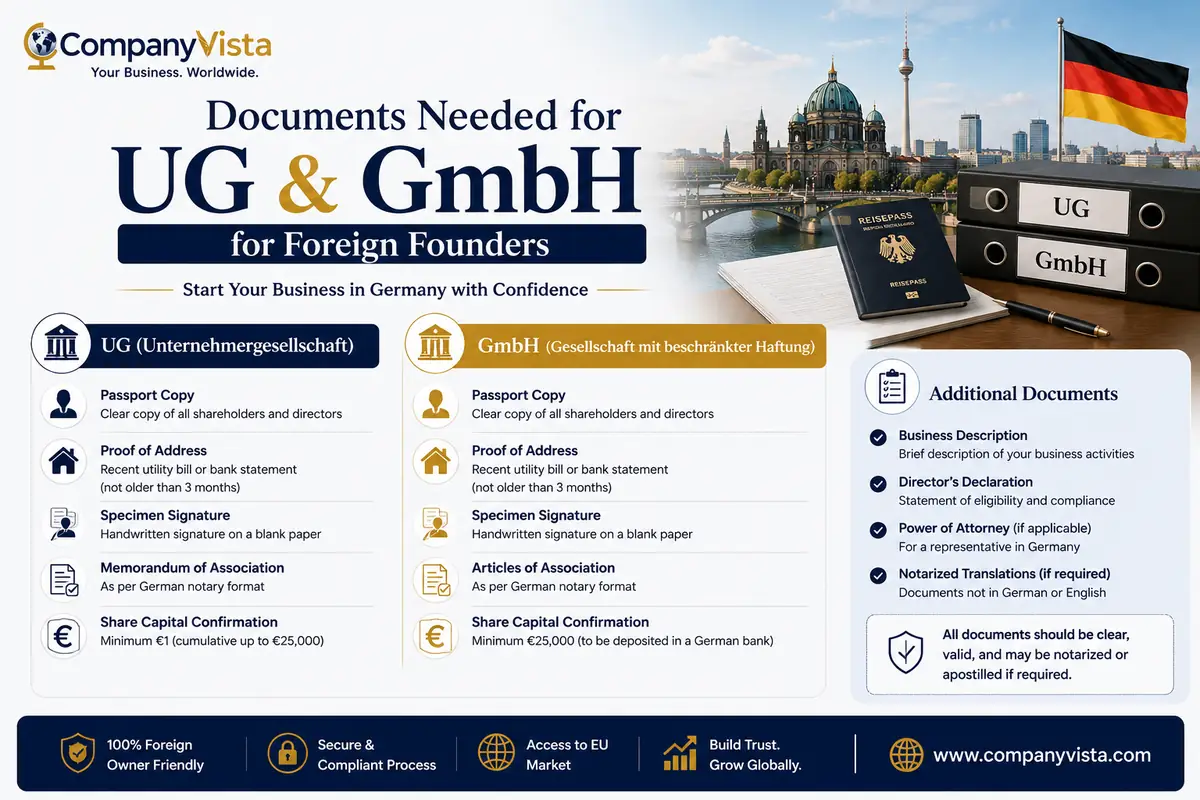
This is the question we are asked most often, and the answer is the same for a UG and a GmbH. Assemble everything before you approach the notary — an incomplete file is the most common reason a German formation stalls for weeks.
| Document | What is required |
|---|---|
| Passport or national ID | For every shareholder and every managing director. Must be valid, and the notary will want a certified copy where you are not attending in person. |
| Proof of residential address | Utility bill, bank statement or residence registration for each individual. Usually must be recent. |
| Tax identification number | Your tax number from your country of residence, for each shareholder and director. |
| Articles of association | The Gesellschaftsvertrag. For a single founder, or up to three shareholders in straightforward cases, the standard Musterprotokoll model protocol is cheaper and faster. |
| Shareholder list | Gesellschafterliste, showing each shareholder and their holding. Filed with the commercial register. |
| German registered address | With evidence — a lease or an office service agreement. Your address abroad cannot be used. |
| Managing director declaration | Confirming no management disqualification. This is a personal declaration and it covers convictions and insolvency events in any country, not only Germany. |
| Proof of share capital deposit | Bank confirmation that the capital has been paid into the company's account. Required before the notary files for registration. |
| Company name check | Confirmation from the local Chamber of Commerce (IHK) that the proposed name is available and not misleading. |
| Certified translations | Documents not in German generally require a certified translation. |
| Apostille | Documents executed abroad usually require an apostille or equivalent legalisation to be recognised in Germany. |
The last two lines are where foreign founders lose the most time. A perfectly valid document from your own country is not automatically usable in Germany — it needs to arrive translated and, in most cases, apostilled. Start that process early, because apostille turnaround in some countries runs to several weeks.
Why a German Notary Is Mandatory
Unlike the UK or the US, where you file a form with a registry, German company formation runs through a notary by law. The articles of association must be notarially recorded, the managing director appointed, and the application to the Handelsregister filed by the notary rather than by you.
The notary is not a formality or an optional service. Under the GmbH Act a company formed without proper notarisation does not come into existence. The notary also carries out identity verification, explains the deed to the parties, and is legally responsible for the accuracy of what is filed.
The sequence after notarisation is worth understanding: the company exists as a UG or GmbH "in Gründung" — in formation — which is enough to open a bank account, but not a fully formed company. Once the capital is deposited, the notary files, the local court (Amtsgericht) enters the company in the commercial register, and the entry is published. Only then is the company legally established.
Online Video Notarisation and Its Limits
Since 1 August 2022, the DiRUG reforms have allowed a cash-formed GmbH or UG to be notarised online, by video, through the secure system operated by the Federal Chamber of Notaries. It is genuinely a significant modernisation, and it is heavily marketed to foreign founders as meaning you never need to travel.
There is a practical catch that most of that marketing omits.
Two further limits. Online formation is available for cash formations only — contributions in kind must be notarised in person. And the procedure is most straightforward for single-shareholder formations by natural persons; more complex shareholder structures are more likely to require an in-person or mixed procedure.
None of this makes video notarisation useless. Where your identity document is compatible, it works well and saves a journey. It simply is not the universal solution it is often presented as, and non-EU founders in particular should confirm eligibility before relying on it.
The Apostilled Power of Attorney Route
Where video notarisation is unavailable — which for non-EU founders is common — the established alternative is a power of attorney, and it works reliably.
You sign a power of attorney in your own country before a local notary, have it apostilled, and send it to Germany. A representative then attends the German notary and executes the formation on your behalf. You never travel, and the company is formed properly.
The trade-offs are honest ones. It costs more, because you are paying for local notarisation, apostille, courier and the representative. It takes longer, because apostille turnaround varies considerably by country. And the wording of the power of attorney matters: a document that is too narrow will be rejected by the German notary and has to be redone, which is the single most common cause of delay on this route.
Have the German notary or your formation agent supply the wording before you sign anything locally. Drafting it yourself and discovering it is insufficient adds weeks.
Share Capital and the Bank Account Problem
This is the sequencing that catches almost every foreign founder, and it is worth setting out plainly.
- The notary records the articles of association. The company now exists in Gründung.
- You open a German business bank account in the name of the company in formation.
- You deposit the share capital — the full amount for a UG, at least EUR 12,500 for a GmbH.
- The bank issues confirmation of the deposit.
- Only then does the notary file for entry in the Handelsregister.
Step 2 is the bottleneck. German banks apply substantial scrutiny to a company whose shareholders and directors are all resident abroad, and several will not onboard one at all. Applications are declined without a detailed reason, and the company cannot complete registration until an account exists.
This is a further argument for the UG when capital is tight: depositing EUR 1 is materially easier than arranging EUR 12,500 into an account that does not yet exist. It is also why we sequence banking early rather than treating it as a final step, and why multi-currency business accounts are often opened alongside for operational use once the company is registered.
The German Registered Address Requirement
Every UG and GmbH must have a German business address recorded in the commercial register. Your address abroad cannot be used, and neither can a bare mailbox.
A virtual office is permitted, provided it offers genuine mail handling and the company can actually be reached there. What the register will not accept is an address at which nothing happens — the requirement is substantive rather than formal, and the tax office may test it. You will need documentary evidence of the address, typically a lease or a service agreement, for the notary and the registration.
Beyond the register, the address determines which local court handles your registration, which tax office you deal with, and — importantly for your tax bill — which municipality levies your trade tax. That last point is covered below and is worth more thought than founders usually give it.
How Company Registration in Germany Works
| Step | What happens | Timing |
|---|---|---|
| 1. Name check | Proposed name checked with the local Chamber of Commerce for availability and compliance. Must carry the correct suffix. | 2–5 days |
| 2. Documents and translations | Passports, address proofs, tax numbers, apostilles and certified translations assembled. The longest preparation step for foreign founders. | 1–4 weeks |
| 3. Registered address | German business address secured with documentary evidence. | Days |
| 4. Notarisation | Articles recorded by a German notary — in person, by video, or through an apostilled power of attorney. Company now exists in Gründung. | 1 appointment |
| 5. Bank account and capital | Account opened for the company in formation and share capital deposited. The least predictable step. | 2–8 weeks |
| 6. Handelsregister filing | Notary files electronically; the local court enters the company and publishes the entry. | 1–3 weeks |
| 7. Trade office registration | Gewerbeanmeldung with the local trade office. | Days |
| 8. Tax registration | Tax questionnaire to the Finanzamt; tax number and VAT ID issued. | 2–6 weeks |
Corporate Tax and VAT in Germany
German company taxation has two layers, and quotes that mention only the first are misleading.
- Corporation tax at 15%, plus a solidarity surcharge of 5.5% levied on that tax — an effective 15.825%.
- Trade tax (Gewerbesteuer), levied by the municipality where the company is based. The rate varies considerably between municipalities because each sets its own multiplier.
Combined, most companies face an effective rate in the region of 30% to 33%. Because trade tax is set locally, your registered address has a genuine effect on your tax bill — a difference of several percentage points between a major city and a smaller municipality is normal. It is worth a conversation before you choose an address, not after.
VAT is 19% at the standard rate with a 7% reduced rate. Registration and periodic returns follow, and a German VAT ID is generally needed to trade within the EU. Your own country of residence will also tax you under its own rules; a German company does not change your personal tax residency.
Costs and Realistic Timeline
Costs fall into three groups: notarial fees, fixed by statute and scaling with share capital; court and registration fees for the Handelsregister entry and publication; and service fees for document preparation, translations, apostilles, the registered address and coordination.
Because Germany is outside the small group of jurisdictions where we publish fixed pricing, we do not quote a headline figure here — the cost depends on entity type, share capital, number of shareholders, whether video notarisation is available to you, and how many documents need translating and apostilling. What we do is provide a written quote covering all of it before any payment is taken, so there is no sequence of surprises.
On timing, a realistic expectation for a foreign founder is six to twelve weeks from starting document preparation to a fully registered and tax-registered company. Notarisation is a single appointment. Document preparation and the bank account account for nearly all of the elapsed time.
Mistakes Foreign Founders Make
| The mistake | What it costs you |
|---|---|
| Planning around video notarisation without checking eligibility | Identification requires a readable electronic ID document. Many non-EU passports are not compatible, and discovering that late forces a restart via power of attorney. |
| Drafting the power of attorney yourself | Wording that is too narrow is rejected by the German notary and must be re-signed and re-apostilled abroad — typically weeks lost. |
| Leaving apostilles and translations until last | Apostille turnaround runs to several weeks in some countries. This is the step to start first, not last. |
| Treating the bank account as a final formality | The company cannot be registered until the capital is deposited. German banks are cautious with wholly non-resident boards, and this is the least predictable step in the process. |
| Choosing a UG to look established | The suffix is read in Germany as a starter entity. If you can fund EUR 12,500, a GmbH opens more doors with banks and corporate customers. |
| Forgetting the 25% UG profit reserve | A legal obligation every profitable year until the reserve reaches EUR 25,000. Not optional, and not something you elect into. |
| Ignoring trade tax when choosing an address | Trade tax is set by the municipality. The same company can face materially different effective rates depending on where it is registered. |
| Using an address with no genuine presence | A virtual office is permitted only if mail is genuinely handled and the company is reachable. A bare mailbox is not sufficient. |
How CompanyVista Helps
CompanyVista is a document filing, taxation and accounting firm — not a law firm. Our team brings together US-credentialed CPAs, IRS Enrolled Agents, Certified Acceptance Agents, chartered accountants and filing specialists, with offices in Noida NCR and Albuquerque, New Mexico. Where a matter genuinely requires legal advice we work alongside independent attorneys in the relevant jurisdiction rather than offering it ourselves.
For company formation in Germany we prepare the document set for your specific nationality, arrange certified translations and apostilles, coordinate the notary — including establishing at the outset whether video notarisation is open to you or a power of attorney is required — secure the registered address, sequence the bank account and capital deposit, and handle the Handelsregister, trade office and tax registrations.
Every engagement begins with a free consultation and a written quote before any payment. We will also tell you when Germany is not the right jurisdiction — if you need a European entity quickly and the German notary and banking sequence does not suit your timeline, there are alternatives worth considering first — Estonia in particular is fully digital and has no notary requirement.